

For farms and feed producers that want to convert alfalfa hay into consistent, high-value pellets for dairy, beef, equine, poultry, or retail bagging, a properly designed alfalfa pellet machine plus a small processing line (grinder, dryer, pelletizer, cooler, screener, bagger) delivers reliable pellet quality, predictable throughput, and attractive unit economics when moisture, particle size, and equipment matching are controlled. Choosing the correct machine type (flat die for small scale, ring die for medium to large scale), matching die thickness and hole diameter to feed goals, and following a disciplined pre-processing routine are the three most important determinants of performance and pellet durability.
1. What is an alfalfa pellet machine
An alfalfa pellet machine is the mechanical device that compresses ground alfalfa meal into cylindrical pellets by forcing the material through die holes under pressure and, in many designs, with a roller assembly riding over the die. Machines for alfalfa pelletizing vary from small flat-die models for on-farm use to heavy ring-die pelleting lines used by feed mills. The output is a dense, uniform pellet that stores and transports more easily than loose hay and can be formulated for specific animals or applications.
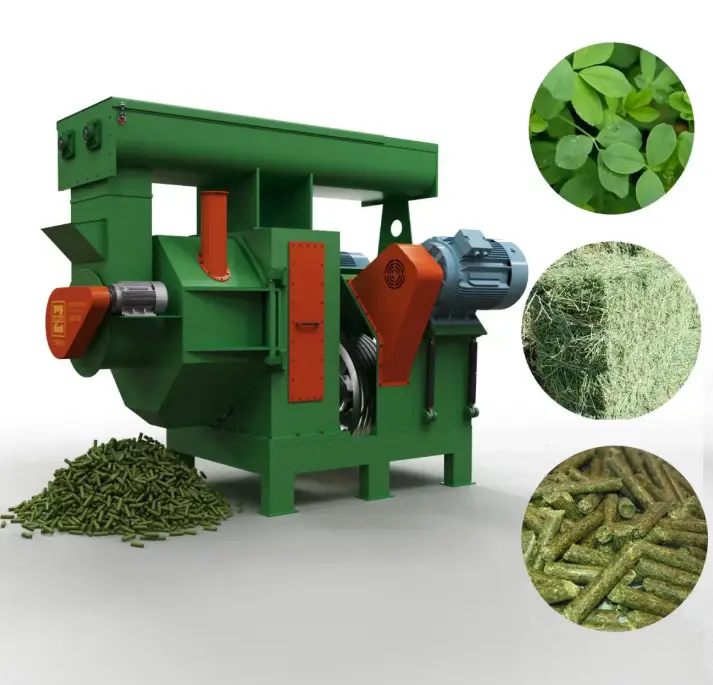
2. Why pelletize alfalfa: benefits and markets
Pelletized alfalfa concentrates feed value into a compact, mixable form. Primary advantages include:
-
Increased bulk density and lower transport cost per unit of nutrient.
-
Easier portion control and automated feeding in confined systems.
-
Reduced waste and selective feeding losses when compared to loose hay.
-
Longer shelf life under proper storage and reduced dust for worker safety.
-
Opportunities to blend alfalfa with other components for target rations.
Key markets: dairy farms (TMR systems), beef finishing, horse feed, rabbit and small-ruminant feeds, aquaculture ingredient blends, retail bagged forage pellets for hobbyists and lawn/soil amendments. Case examples of operational scale range from single-farm pelletizers to multi-ton/hour feed mills.
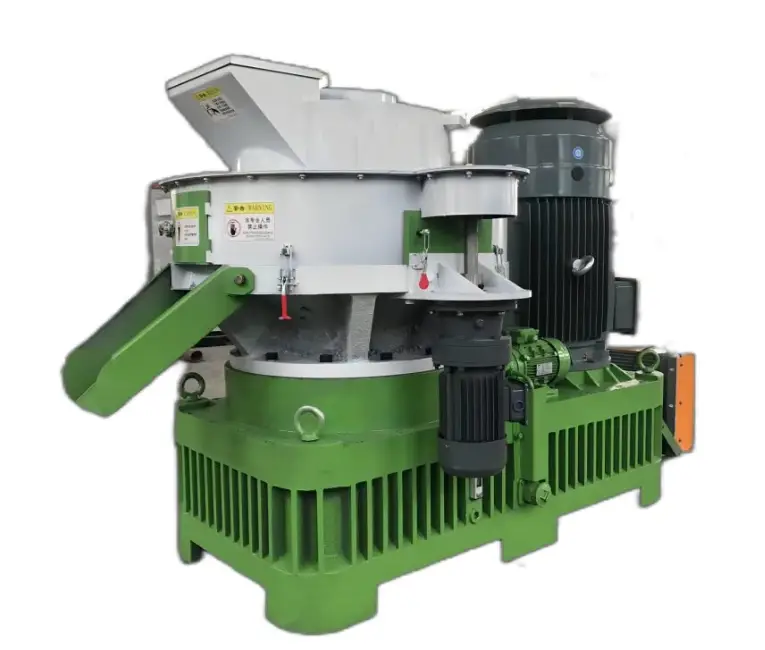
3. Types of pellet machines and how they differ
Pellet machines fall into several broad families. The choice affects throughput, pellet quality, operating cost, and required pre-processing.
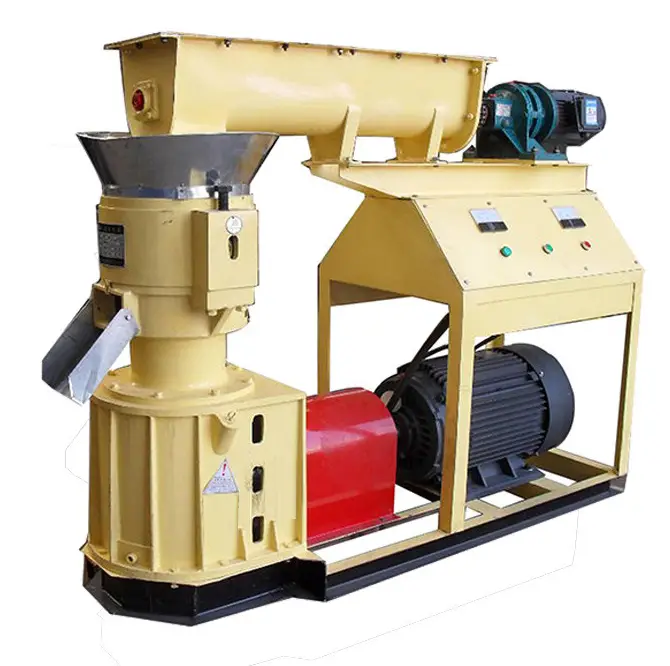
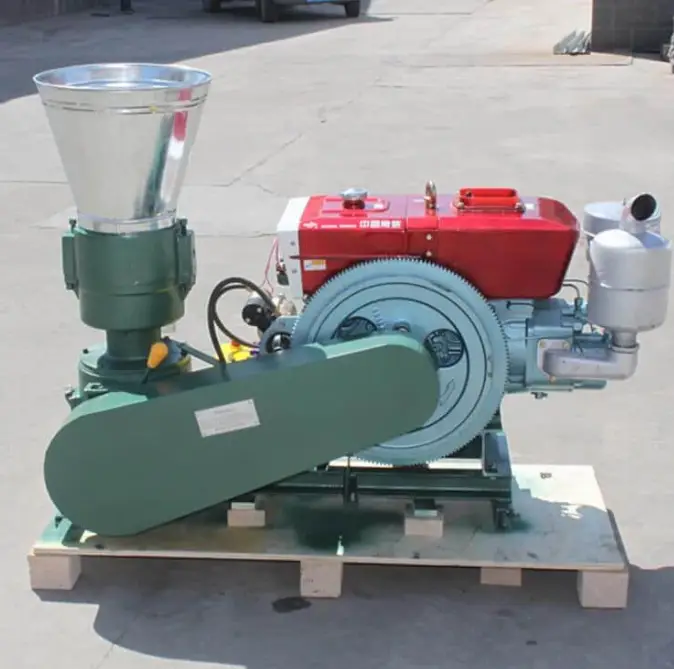
Flat die pellet mills
-
Common for small farms and on-site production.
-
Simpler construction, lower capital cost, easy to maintain.
-
Capacity typically lower (tens to a few hundred kg/hour).
-
Best for small batches or experimental mixes.
Ring die pellet mills
-
Industrial standard for larger throughput and more uniform pellet geometry.
-
Higher initial cost but better energy efficiency at scale and longer die life per unit produced.
-
Suitable for continuous feed mill lines; capacities range from several hundred kg/h to multiple tonnes/h.
Mobile/on-field harvest pelleting (specialized)
-
Harvest units that pelletize directly in the field exist for stalk crops and forage; these combine collection and pelleting to reduce transport of bulky feedstock. Examples include field pelleting presses used for lucerne/alfalfa stalks.
4. Typical pellet plant layout and core components
A small to mid-sized alfalfa pellet production line typically includes:
-
Receiving and storage for baled or loose alfalfa.
-
Pre-crusher / hammer mill to reduce particle size to the target range.
-
Dryer to reach the correct moisture content for pelleting (see section 5).
-
Pelletizer (flat or ring die) with electric or diesel powertrain.
-
Cooler to bring pellet temperature and moisture to storage specification.
-
Screener to remove fines and oversized particles.
-
Bagging / packing / palletizing station for finished pellets.
A complete line also needs conveyors, dust control, and a small PLC or control panel for automation in medium to large systems. Several turnkey suppliers offer lines scaled from farm to industrial capacity.
5. Raw material preparation: particle size, moisture, and additives
Reliable pellet quality starts before the pelletizer.
Particle size
Ground alfalfa should be reduced to a uniform particle size; typical target: 1–5 mm depending on die hole diameter and machine type. Hammer mills are the usual pre-grinding equipment. Proper particle reduction increases die filling consistency and reduces power spikes.
Moisture content
Optimal moisture for alfalfa pelleting is typically in the 10–15% range (often 12–14% recommended by many manufacturers). Too wet leads to plugging and poor pellet quality, too dry increases die wear and reduces pellet cohesion. Use a dryer and moisture meter to control this parameter consistently.
Binders and additives
Alfalfa often pellets well on its own, but some formulations add 1–3% binders (molasses, vegetable oils, or colloidal clays) to improve pellet durability and reduce fines for certain applications. For feed destined to high-performance animals, additive choice should consider palatability and regulatory limits.
6. Pelleting process step-by-step
-
Feedstock inspection and removal of contaminants (stones, metal, plastic)
-
Grinding to consistent particle size with a hammer mill or crusher
-
Drying to target moisture; measure with a moisture probe
-
Blending (if adding binders, minerals, or other forages) in a paddle mixer
-
Feeding the pelletizer at a steady rate using a screw feeder or gravity feeder
-
Pelleting: monitor motor load, die temperature, and pellet integrity; adjust feeder speed and steam/binder dosing if equipped
-
Cooling pellets immediately to below 35°C and the final moisture specification to prevent molding during storage
-
Screening to remove fines and recirculate them to the process or re-grind
-
Packaging or bulk loading with proper desiccation if long term storage is planned
Operational tips: keep tooling sharp and free of buildup; maintain consistent feed rate; and record production metrics daily for continuous improvement.
7. Pellets: key quality metrics, typical sizes and specifications
Critical pellet properties
-
Diameter: commonly 6 to 8 mm for animal feed pellets; smaller sizes (2–4 mm) for certain pets or aquaculture; larger for fuel pellets.
-
Length: typically 1 to 1.5 times diameter; often cut by knife on discharge
-
Bulk density: important for transport cost and flowability
-
Durability: percent retained after tumbling or impact testing; higher is better for shipping
-
Moisture: final product moisture should usually be below 12% for stable storage
Table 1: Typical physical specs for alfalfa feed pellets
| Parameter | Typical Range (feed pellets) | Notes |
|---|---|---|
| Diameter | 6–8 mm | 6 mm common for small ruminants; 8 mm common for dairy/large cattle |
| Length | 6–12 mm | Pellet length often set by knife or die design |
| Moisture (finished) | 8–12% | <12% preferred for long storage |
| Bulk density | 450–650 kg/m³ | Varies by compression and particle composition |
| Durability | 85–98% | Measured by standard tumbling tests |
Table 2. Typical nutritional snapshot of plain alfalfa pellets
| Nutrient | Typical value (dry matter basis) |
|---|---|
| Crude protein | 15–22% |
| Neutral detergent fiber (NDF) | 25–40% |
| Acid detergent fiber (ADF) | 20–30% |
| Digestible energy | Variable by animal species |
Note: exact nutritional values depend on alfalfa variety, cutting stage, and drying method. Always test representative samples if formulating rations.
8. How to choose machine capacity and power — sizing examples
Machine selection should be made from expected daily throughput, batch practice, and power availability. Below is a simplified sizing guide; consult engineering for precise line design.
Table 3. Example machine capacities and power (representative supplier data)
| Machine type | Typical model/power | Typical capacity (dry alfalfa) | Notes |
|---|---|---|---|
| Small flat die (farm) | 7.5–15 kW electric | 80–250 kg/h | Portable, low capex |
| Medium ring die | 30–55 kW electric | 500–1200 kg/h | Suits medium farms and small mills |
| Large ring die | 75–250 kW electric | 1–5+ tonnes/h | Industrial feed mills and commercial plants |
These ranges are illustrative. Many manufacturers publish specific model charts with capacity based on alfalfa characteristics and die specs. Example commercial product lines present capacities from a few hundred kg/h to multi-ton per hour where feed conditioning and pre-drying are included in the turnkey offering.
9. Installation, operation, maintenance, safety and troubleshooting
Installation & commissioning
-
Site requirements: stable concrete foundation, proper electrical supply, and dust extraction.
-
Commissioning: verify alignment, check roller/die clearance, test feeders without load, and conduct a few short runs with sample alfalfa.
Routine maintenance
-
Inspect and rotate dies and rollers per hour-based schedule.
-
Clean buildup on die holes and roller surfaces after each run.
-
Monitor and replace worn knives, bearings, and electrical components before failure.
Safety
-
Install guards around moving parts, emergency stops, and lockout/tagout procedures for maintenance.
-
Implement dust control and spark detection if processing dry biomass to minimize fire risk.
Common problems and fixes
-
Low pellet density: Check moisture and particle size; reduce feed rate or adjust die/roller gap.
-
Frequent die plugging: Dry material further or add a small binder; inspect for contaminants.
-
High fines: Increase conditioning time or reduce knife speed; verify die condition.
-
Motor overload: Reduce feed rate; inspect for foreign material jamming the die.
10. Economic considerations and return on investment
Key drivers of ROI: feed value premium for pellets, transport savings, labor and energy costs, and machine capital cost. A simple sample cost table below helps framing.
Table 4. Sample ballpark capital and operating cost elements (USD, illustrative)
| Item | Small farm line | Medium plant | Notes |
|---|---|---|---|
| Pellet mill (machine) | $2,000–$12,000 | $25,000–$120,000 | Flat die vs ring die |
| Grinder + dryer + cooler | $4,000–$20,000 | $30,000–$200,000 | Depending on capacity |
| Installation & conveyors | $1,000–$5,000 | $10,000–$80,000 | Site specific |
| Energy (kWh/ton) operating | $30–$80 per ton | $15–$50 per ton | Varies with scale and efficiency |
| Labor (operator) | 0.1–0.5 FTE | 1–3 FTE | Depends on automation |
Breaking even depends heavily on local alfalfa price, pellet premium, and sales volume. On-farm producers often find payback attractive when transport savings and value-added bagging yield a better net price to the farm. For commercial buyers, scale and automation reduce per-ton cost. Supplier quotes and a local market study are recommended before committing to major capital.
11. Environmental and feed-safety considerations
Pelletizing alfalfa is generally low carbon when feedstock is local and no fossil binder is used; manufacturing inefficiencies can increase the life-cycle footprint if long distance transport or high drying fuel is required. For feed safety, ensure the alfalfa is free from pesticide residues out of specification, and follow local feed regulations for additives and labeling. Proper cooling and moisture control are critical to prevent mold growth in the packaged product.
12. LansonMachines offering: manufacturing, customization, and factory pricing
LansonMachines manufactures complete alfalfa pellet machines and small to medium pellet lines at 100% factory price. Our standard offerings include:
-
Small flat die pellet mills suitable for single-farm production with compact footprints.
-
Mid-range ring die pellet mills for coops and small commercial enterprises.
-
Full turnkey lines: hammer mill, dryer, ring die pellet mill, cooler, screener, and bagging.
-
Custom engineering for die hole size, pellet density targets, feed conditioning options, and electrical configurations to match local power grids.
-
Technical support for commissioning and training programs for operators.
When comparing suppliers, request published performance curves for alfalfa on the selected die, energy consumption per ton, warranty terms, and spare parts availability. LansonMachines provides OEM parts, and can ship internationally with standard packing and inspection documentation.
13. FAQs
Q1: What moisture should alfalfa be for pelleting?
A1: Target 10–15% moisture at pelleting; many producers aim for ~12–14% for best balance between throughput and pellet durability. Use a dryer and moisture meter for consistency.
Q2: Can you pelletize fresh (wet) alfalfa?
A2: Fresh wet alfalfa usually requires mechanical dewatering and significant drying prior to pelleting. High moisture can cause plugging, poor durability, and microbial risks.
Q3: Which is better for alfalfa: flat die or ring die?
A3: Flat die is fine for low volumes and lower capital budgets. Ring die gives higher throughput, better pellet uniformity at scale, and lower energy per ton for continuous production. Select based on expected daily output and long-term plans.
Q4: Do alfalfa pellets need binders?
A4: Not always. Alfalfa often pellets without binders, but 1–3% molasses or similar agents can improve durability for certain mixes or for very dry materials.
Q5: What pellet diameter should I choose?
A5: 6–8 mm is common for livestock—6 mm for small ruminants and young animals; 8 mm for adult cattle. Check customer preferences and feed system compatibility.
Q6: How do I test pellet durability?
A6: Use a standard tumbling or drop test to measure percent retained over a fixed time; many mills reference an industry durability standard for acceptance testing.
Q7: How much power does a pellet mill need?
A7: Small flat die mills may need 7.5–15 kW. Medium ring die systems commonly need 30–70 kW; large industrial lines greatly exceed this. Consult supplier curves for alfalfa because fiber content and moisture affect power draw.
Q8: Can alfalfa pellets be used for biofuel?
A8: Pellets made from alfalfa can be used as biomass fuel, but composition and economics typically favor forage use. If intended for fuel, choose higher density die specs and ensure combustion systems accept the ash profile.
Q9: How do I prevent mold in stored pellets?
A9: Cool pellets promptly below 35°C and ensure final product moisture under ~12%. Package in breathable bags or bulk with desiccation and keep in dry storage.
Q10: What ongoing costs should I budget for?
A10: Plan for electricity, spare dies/rollers, knife and bearing replacements, periodic reconditioning, consumables like lubricant, and routine filter/dust collector upkeep.