

For small-scale grain pellet production, whether for livestock feed, poultry, pet food, or compact biomass fuel, a compact flat-die grain pellet machine driven by an appropriate motor (electric, diesel, or PTO) typically gives the best balance of low capital cost, ease of use, flexible feedstock handling, and fast payback for micro-farms and small workshops. For production above roughly 1–2 tons per hour, consider a ring-die system; for <1 ton/hour, flat-die designs deliver lower operating complexity and simpler maintenance while still producing feed-grade pellets when upstream grinding and moisture control are correct.
1) What is a small scale grain pellet machine?
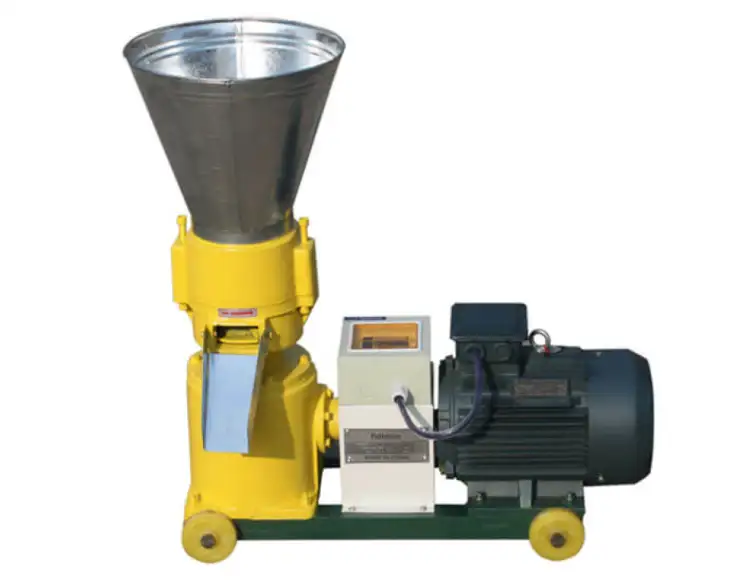
A small scale grain pellet machine compresses ground grain mash or compound feed into compact cylindrical pellets through mechanical pressure and heat generated at the die. These pellets are denser, easier to store, reduce dust and waste, and can improve feed handling and animal intake. Small machines are typically intended for farms, backyard operations, pilot production, or small feed-for-sale businesses. Flat-die units dominate this segment because they are compact and inexpensive; ring-die units are reserved for larger continuous production.
2) Why small-scale pelleting matters (use cases and business cases)
Small-scale pelleting is used for:
-
On-farm feed production (custom formulations for poultry, pigs, rabbits, cattle).
-
Specialty feeds (herbal, medicinal, or niche pet diets)
-
Upcycling local grain or byproduct into transportable, value-added pellets.
-
Small community biomass fuel production for heating or sale.
-
Research, R&D, and recipe testing before scaling.
Commercially, small machines reduce purchases of premixed feed, help control ingredient quality, and in some geographies cut costs substantially when transport or packaged feed prices are high. Small pelleting can also be the first step in a staged scale-up to a mid-sized feed business; small units serve as pilots for product recipe, pellet size, and binder testing. Several industry guides show that a sub-10k (ton/year) plant can be economic with careful sourcing and demand.
3) Key machine types and how they differ
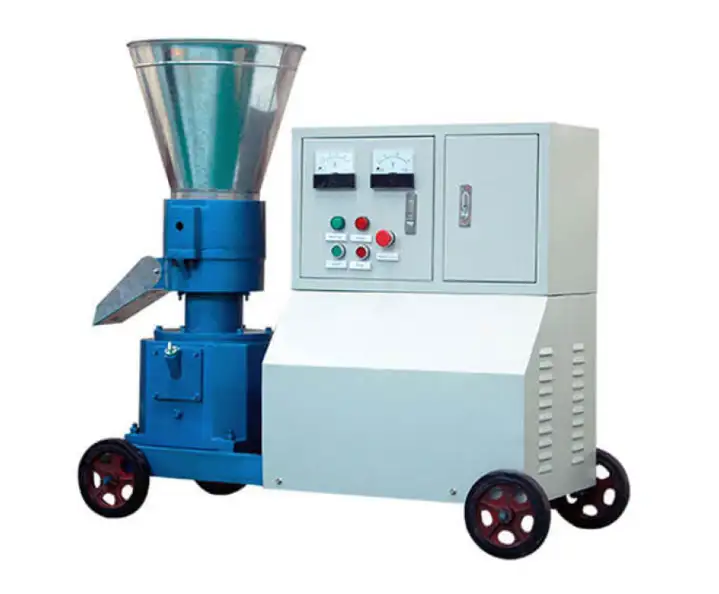
Flat-die pellet mill (best for small scale)
-
Die is flat with holes; rollers force material through from above.
-
Advantages: lower cost, easier to maintain, visible process, ideal for occasional batches and mixed materials.
-
Typical small capacities: roughly 50–800 kg/hour depending on motor and die size.
Ring-die pellet mill (industrial and high throughput)
-
A cylindrical die with internal rollers; designed for continuous large production.
-
Advantages: higher capacity, more consistent pellets, longer die life for heavy use; better for hard or dense formulations.
-
Disadvantages: higher capital cost and more complex maintenance.
Vertical and PTO units
-
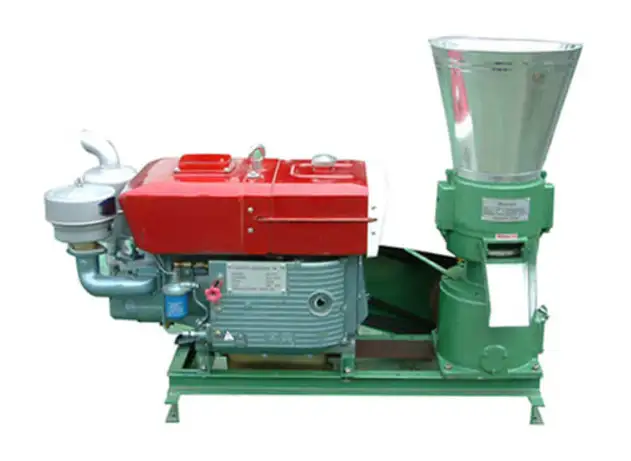
Vertical ring or vertical flat designs reduce footprint and can be adapted to tractor PTO drive for off-grid farm use. PTO units are useful where electricity is intermittent.
Short selection rule: if your expected average throughput is under ~1 ton per hour and you value lower capital/maintenance, choose a flat-die small pellet machine. If you need continuous high throughput and maximum pellet consistency, choose ring-die.
4) How pellet formation works — the physical principles simplified
Pellet formation is pressure and friction driving adhesion between particles. Heat generated by compression softens natural binders (for grains, starches gelatinize; for woody biomass, lignin plasticizes). Material is forced through die holes where the combination of pressure, temperature, and shear compacts particles into a dense cylinder. Conditioning (steam or water addition + mixing) before the die increases pellet durability by improving the binding mechanisms. Proper particle size and moisture are critical; incorrect inputs produce high fines, dust, or fragile pellets. (See pre-processing below.)
5) Raw material and preprocessing — the most important practical steps
5.1 Grinding (particle size)
-
Grain and ingredient particles must be reduced to a fineness that allows uniform compression. For most feed pellets, the target is much finer than raw grain — often under 1.0 mm for sensitive diets, though coarse pellets for ruminants can be larger. Hammer mills with appropriate screens are the typical upstream grinder. Finer grinding improves pellet quality and conditioning efficiency but increases energy and wear.
5.2 Moisture control (conditioning)
-
Moisture is critical. Typical recommended pre-conditioning moisture ranges for feed/grain mash fall roughly between 12% and 16% for good pelleting behavior; wood biomass often starts around 13% to 16% before pelletizing and finishes lower after cooling. Finished pellets for fuel aim for low “as packaged” moisture (often 6–10%). Overly dry mash leads to brittle pellets; overly wet mash causes sticking and machine blockage. Use a moisture meter and adjust with steam or water sparingly.
5.3 Binders and additives
-
For grain-only mixes the natural starch can bind when conditioned. For high-fiber or difficult mixes, small amounts of molasses, vegetable oil, or commercial binders (1–3% typical) improve integrity. Salt levels and fat content also change compression and die wear. Test small batches and document recipes.
5.4 Temperature and conditioning
-
Conditioning with steam raises temperature, helps gelatinize starch, and improves pellet durability. Typical conditioning temperatures vary by product but are often in the ~70–90°C range for feed; controls are preferred to avoid overcooking or microbial risks.
6) Typical specifications and how to compare models
Core comparative specs
-
Capacity (kg/hr): real-life throughput depends on material, die size, and motor. Small units commonly list 50–800 kg/hr; larger flat-die / small ring units scale up from there.
-
Motor power (kW or HP): match motor to expected load. Small electric models may use 3–15 kW motors; PTO or diesel options vary by model.
-
Die diameter and hole size: determines pellet diameter options (commonly 2–8 mm for feed; 6–10 mm for larger livestock; fuel pellets often 6–8 mm).
-
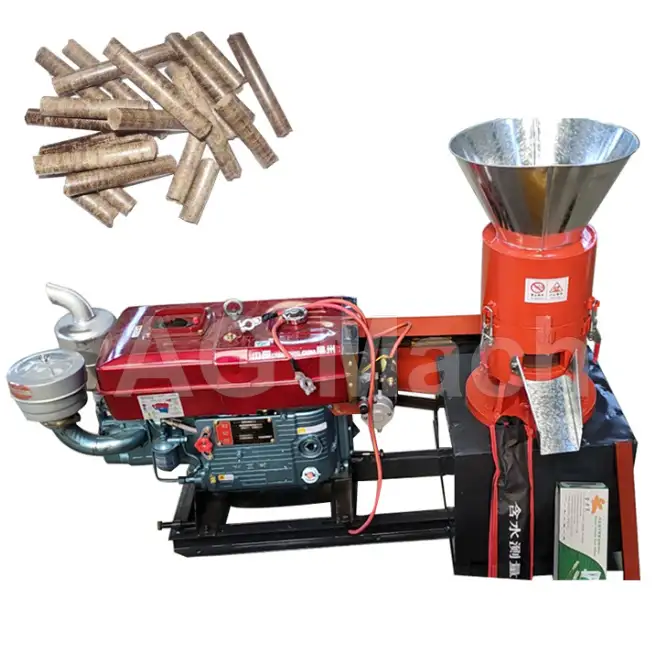
Drive type: electric, diesel, gasoline, or PTO. Choose by available power and intended field use.
-
Material compatibility: some mills list both “feed and biomass”; confirm die and roller metallurgy if processing abrasive materials.
-
Spare parts availability: dies, rollers, bearings, seals. Flat-die mills usually have cheaper, easier-to-source spares.
7) Auxiliary equipment for a reliable small production line
For a consistent product, the minimal auxiliary line includes:
-
Hammer mill or grinder (adjustable screen sizes; typical sawdust uses 1–3 mm screens).
-
Mixer (batch or continuous) for formulation uniformity.
-
Conditioner or steam addition (optional but recommended for feed formulations).
-
Dryer or sun-drying step (if raw moisture is high).
-
Pellet cooler and screener (pellets exit hot and soft; cooling hardens them and reduces breakage).
-
Weighing and bagging station for sales packaging.
Auxiliary tools improve pellet quality and reduce post-production losses; the exact mix depends on target product and budget.
8) Typical costs, price bands, and ROI considerations
-
Small flat-die units for home/farm use: many listings for smaller electric models range from roughly US$1,500 to US$6,000 depending on capacity and features. For example, compact flat-die machines advertised for small production commonly fall in that band.
-
Small industrial/mini plant units: more robust flat-die or small ring-die packages (with grinder, mixer, and ancillary equipment) move into the tens of thousands of dollars.
-
Large production equipment: ring-die systems and complete plants can be many tens to hundreds of thousands, or millions for turnkey commercial plants.
ROI ballpark: Profitability depends on feedstock cost, local feed prices, demand, and labor. Feasibility studies and industry analyses indicate payback anywhere from under 2 years to multiple years, with small plants showing attractive returns when raw material and local market conditions are favorable. Use conservative assumptions on sales and account for maintenance and energy per ton.
9) Operation plan: step-by-step small-batch workflow and QC checks
-
Weigh and prepare recipe: measure grain, protein, fat, minerals.
-
Grind to target particle size for the animal class (e.g., 0.6–1.0 mm for piglet diets; larger for adult ruminants). Test with sieve.
-
Mix thoroughly, add oil or binder if required.
-
Condition with steam or controlled water spraying to reach target moisture (12–16% typical). Use a moisture meter.
-
Pelletize: start the pellet mill, feed the mash at a controlled rate. Monitor pressure, sound, and pellet quality.
-
Cool and screen: cool pellets to ambient and remove fines. Measure pellet durability index (if equipment available).
-
Bag/store in low-humidity conditions. Label batch and record recipe details.
QC checks: pellet diameter, bulk density, moisture after cooling, and a crush test or durability index for product consistency.
10) Maintenance, spare parts, and common troubleshooting
-
Daily: clean feed path, check lubrication points, inspect die, remove stuck particles immediately.
-
Weekly: check bolt torque, inspect belts and pulleys, ensure cooling and ventilation.
-
Monthly: measure die and roller wear; replace worn parts when performance or pellet quality drops.
-
Common issues:
-
Sticking/bridging: usually high moisture or oil; dry and adjust feed.
-
Low output or fines: check particle size (too coarse), low moisture, or worn die/rollers.
-
High vibration/noise: misalignment, loose bolts, or bearing failure.
Flat-die units have simpler spare parts (flat dies and rollers) while ring-die repairs are more complex and may require specialized service.
-
11) Safety, space, and installation tips
-
Allow ventilation for dust control; install dust extraction if producing frequently.
-
Use guarding over moving parts and emergency stops.
-
Place on level concrete or solid base; secure bolt mounts.
-
Train operators on startup/shutdown sequences and safe cleaning procedures.
-
Keep fire suppression (extinguisher) nearby, especially when processing dry biomass.
12) Representative product comparison (quick reference tables)
Table A. High-level flat-die vs ring-die comparison
| Feature | Flat-die (small scale) | Ring-die (industrial) |
|---|---|---|
| Typical capacity (small models) | 50–800 kg/hr | 1,000 kg/hr and above; industrial tens of tons/hr |
| Capital cost | Low (hundreds to a few thousands USD) | High (tens of thousands+ USD) |
| Maintenance | Simple, cheaper parts | More complex, higher uptime importance |
| Pellet consistency | Good for small batches | Very consistent for continuous run |
| Best use | Home, farm, pilot, niche feed | Commercial feed plants, fuel factories |
Table B. Typical small-line equipment and indicative price bands (representative)
| Item | Typical small-scale spec | Indicative price band (USD) |
|---|---|---|
| Flat-die pellet mill | 3–15 kW motor; 50–800 kg/hr | $1,500–$6,000 |
| Hammer mill (small) | 1–10 kW; adjustable screens | $800–$4,000 |
| Mixer (batch) | 50–500 kg capacity | $300–$2,000 |
| Cooler & screener | Small tray or rotary cooler | $1,000–$6,000 |
| Bagging & weighing | Semi-auto scale | $500–$3,000 |
| Total small line | Basic setup for pilot/home production | $4,000–$25,000 depending on specs |
13) FAQs
1. What pellet diameter should I choose for chickens vs cattle?
Chickens and broilers commonly use 2–4 mm pellets; larger poultry and cattle prefer 4–8 mm or 6 mm respectively. Match pellet size to animal mouth size and intake behavior.
2. Can I pelletize whole corn or must it be ground?
Whole corn should be ground first. Uniform particle size ensures good compression and reduces fines. Hammer mills or roller mills are the usual choices.
3. How important is moisture, and how do I check it?
Moisture critically affects pellet quality; aim ~12–16% for feed mash before pelleting depending on the formula. Use a fast moisture meter or oven-dry method to verify.
4. Are flat-die pellets identical to ring-die pellets?
They can be similar in many attributes, but ring-die systems generally give higher density and uniformity at high volume. For small batches, flat-die is usually acceptable and much cheaper.
5. Do I need a steam conditioner?
For many feed recipes, conditioning improves pellet durability. Small operations sometimes use controlled water or short steam additions; more precise conditioning gives better consistency.
6. What maintenance parts should I stock?
Keep an extra die, a set of rollers (or rollers re-machining plan), belts, bearings, and seals. Flat-die spares are cheaper and faster to replace.
7. Can a small pellet mill run on a generator or tractor?
Yes; many small models have diesel/gasoline or PTO options for off-grid use. Ensure the generator/tractor supplies the correct continuous power rating.
8. How do I test pellet durability at small scale?
Basic test: weigh 100g of cooled pellets, tumble in a drum for a set time, sieve out fines and weigh remaining whole pellets. For industry metrics, use a pellet durability index tester.
9. How do pellet machines handle high-fat or sticky recipes?
High fat or sticky binders can clog dies and increase fines. Use lower addition rates, pre-blend oils, or use specialized dies/coatings designed for sticky mixes. Regular cleaning and a slightly lower feed rate help.
10. Where should I install the machine in my facility?
Level, dust-controlled area with good ventilation, near the grinder and mixer to minimize transfer distances. Keep storage dry and cool. Install emergency stop and adequate lighting.
14) Short buyer checklist (quick)
-
Confirm real tested capacity with your actual feed formulation and intended pellet diameter.
-
Ask for detailed motor and power requirements (continuous rating).
-
Request spare parts list and lead times.
-
Verify warranty terms, onsite or remote support, and recommended maintenance intervals.
-
Ask for references or short videos of the model pelletizing materials like yours (e.g., corn + soybean meal).
-
Confirm packaging and shipping — does quoted price include necessary export documentation if ordering overseas?
Final recommendation and LansonMachines note
For a small-scale grain pellet solution that balances price, simplicity, and performance, LansonMachines recommends a flat-die pellet mill matched to a small hammer mill and batch mixer, with a modest cooler/screener. This configuration keeps upfront costs lower, simplifies maintenance, and gives you the flexibility to test multiple formulations. LansonMachines offers factory-direct pricing, customization on die sizes and power options, and support packages for commissioning and spare parts so you can move from pilot batches to steady small production quickly.