

A well-designed sawdust pellet press machine converts low-value wood residues into high-density fuel pellets with consistent quality, low transport costs, and strong market demand; success depends on controlling raw-material moisture, selecting the correct die type and size, matching motor power to target throughput, and installing drying and cooling stages in the production line.
1. What is a sawdust pellet press machine?
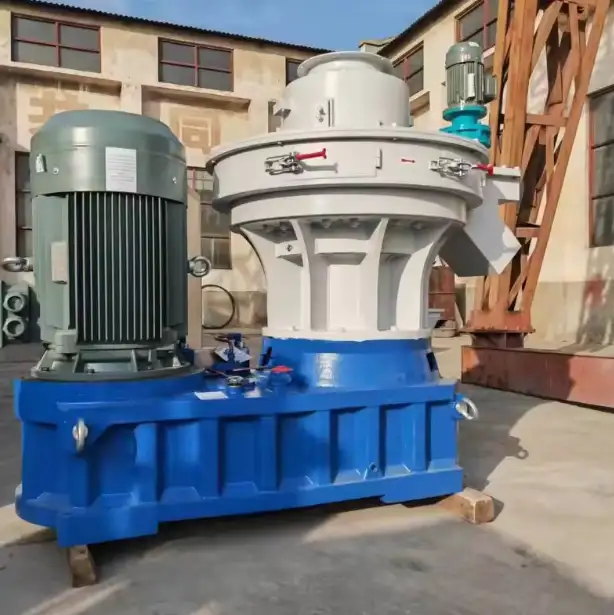
A sawdust pellet press machine compacts shredded wood residues into cylindrical pellets by applying pressure and heat. Compression causes natural lignin in woody feedstock to plasticize and bind particles into a dense, abrasion-resistant pellet. Finished pellets are easier to transport and burn more cleanly than loose chips or dust, which increases their market value for residential heating, industrial boilers, and co-firing power plants.
Primary benefits
- Adds value to waste streams from sawmills and furniture shops
- Improves storage and handling density (bulk density ~600–700 kg/m³)
- Produces a standardized fuel that meets regional quality schemes (ENplus/CANplus/ISO).
2. Typical production routes and the full process flow
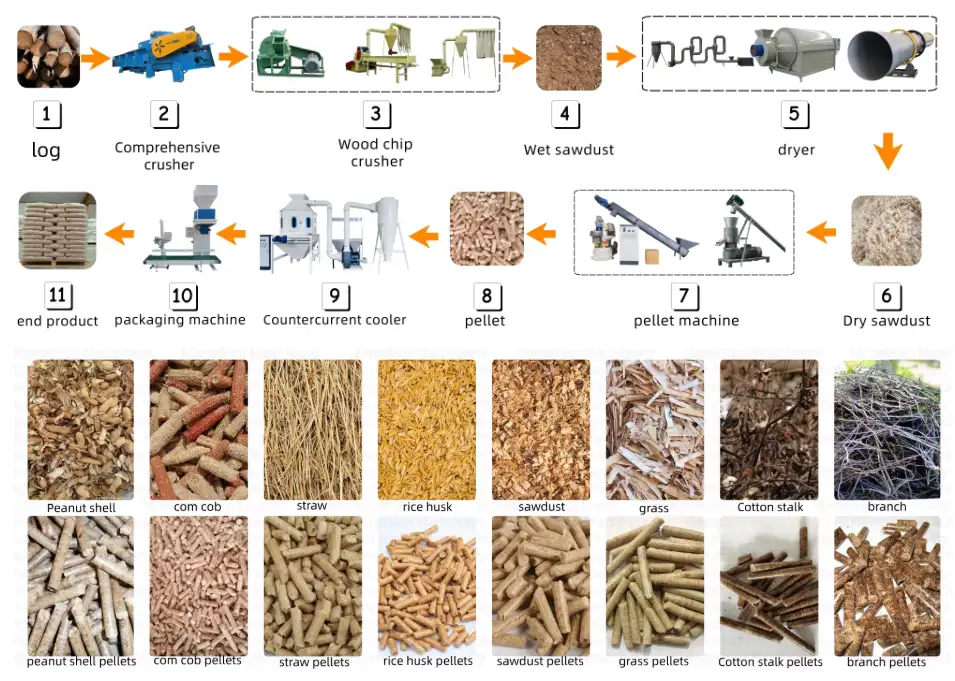
A small-to-medium sawdust pellet line usually follows these steps:
- Raw material sourcing and inspection
- Crushing/shredding (if lumps present)
- Drying to target moisture range (see Section 5)
- Pre-screening and magnetic separation
- Pelletizing (flat-die or ring-die press)
- Pellet cutting and immediate discharge
- Cooling to near-ambient temperature and moisture stabilization
- Screening for fines and packing or storage
This sequence is standard for small units up to industrial lines; missing any stage commonly reduces pellet durability or increases fines. Modern lines frequently include automated feeders and PLC control for throughput stability.
3. Types of pellet presses and how to choose
Flat-die pellet mills
- Best for small-scale and hobby production (50–600 kg/h typical).
- Advantages: lower capital cost, easier maintenance, compact.
- Limitations: lower continuous throughput and shorter die life under heavy use.
Ring-die pellet mills
- Designed for medium to large output (from ~0.5 t/h to multiple t/h).
- Advantages: higher capacity, better energy-per-ton performance, longer service life per production hour.
- Typical heavy-duty models list main motors from 90 kW upward for multi-ton throughput.
Mobile / engine driven / PTO units
- Diesel, gasoline, or tractor driven models for on-site pellet production where grid power is absent.
- Capacity ranges widely (50–300 kg/h typical for portable models); useful for remote sawmills.
Choice checklist
- Target throughput (kg/h or t/h)
- Available feedstock type and continuity
- Power availability and cost
- Budget for capital and spare parts
- Local requirements for pellet quality certification
4. Key technical parameters and comparative specification table
Below is a condensed technical spec table that illustrates typical ranges across family models. Use it as a starting point when sizing a machine.
| Parameter | Small flat-die (home) | Small/medium ring-die | Industrial ring-die |
|---|---|---|---|
| Nominal capacity | 50–200 kg/h | 200–1000 kg/h | 1–5+ t/h |
| Main drive power | 5–22 kW | 22–90 kW | 90–250+ kW. |
| Typical pellet diameters | 4–8 mm adjustable | 6–8 mm common | 6–10 mm common |
| Die/roller wear life | weeks under heavy use | months | months/years with maintenance |
| Typical specific energy | 15–60 kWh/ton (varies widely) | ||
| Typical investment (machine only) | low (USD hundreds–few thousands) | USD 10k–80k | USD 100k+ (line higher) |
Notes
- Manufacturer curves vary; consult datasheets for exact capacity vs. motor load. For ring-die machines, forced feeders and conditioners increase capacity and stability.
5. Raw material requirements: particle size, moisture, binders, pre-treatment
Particle size and homogeneity
- Ideal sawdust is fine and consistent. Coarser chips require hammer milling to reach D50 values conducive to low-energy pelleting. Finer feed reduces specific energy and improves pellet integrity. Research shows reducing particle size can cut energy consumption significantly.
Moisture content (critical)
- Target inlet moisture typically 10–15% for many woody feedstocks; some suppliers specify 12–15% before pelleting; pellet output will be hot and elevated moisture and requires cooling and drying to reach storage moisture (~10–12% or lower for premium grades). Improper moisture leads to low durability, fines, and die plugging.
Binders and additives
- Wood sawdust often binds using its own lignin when pressure and friction heat exceed lignin softening temperature. Non-wood feedstocks or very low-lignin blends may benefit from small binder additions (starch, molasses). Use only what certification/regulations permit for your market.
Contaminant control
- Remove metals (nails, screws) by magnets; screen out stones, plastics and metal to avoid die and roller damage.
6. Energy use, throughput economics, and efficiency levers
Typical energy ranges
- Reported energy consumption varies by feedstock, mill type, and process design. Industry sources place electrical energy in a broad range: approximately 15–60 kWh per ton for many pellet operations, with well-optimized plants approaching the lower end and more challenging feedstocks or poorly sized lines toward the upper end. Recent case studies and technical reviews present figures across that spectrum and note potential savings via improved conditioning and feed homogeneity.
Main cost drivers
- Raw material cost and drying energy
- Electricity (drive motors, conveyors, fans)
- Labor and maintenance (dies, rollers)
- Capital amortization and financing
Efficiency levers
- Reduce moisture before pellet press using efficient drying (belt or rotary dryer)
- Improve feed uniformity with milling and screening
- Use appropriate die thickness and quality steel for longevity
- Employ heat recovery and optimized fans to lower auxiliary power
7. Pellet quality standards, fuel properties and storage
Standards overview
- ENplus and ISO 17225-2 define graded pellet classes (A1/A2/B) for residential and commercial uses; they regulate diameter, moisture, ash percentage and mechanical durability. Certification increases marketability in Europe and other regions.
Key fuel properties
- Pellet diameter: common 6 mm and 8 mm for residential; larger diameters used for some industrial applications.
- Bulk density: ~600–700 kg/m³ (depends on compaction and raw material).
- Calorific value: typical net calorific value ~4.7–5.0 kWh/kg (≈17–18 GJ/ton) for dry wood pellets with low ash.
- Ash content: premium softwood pellets 0.2–0.7%; straw or agricultural pellets higher (up to several percent). Certification schemes specify limits.
Storage and handling
- Keep pellets dry; control humidity and prevent long-term storage in hot conditions that might encourage fungal growth or spontaneous heating in bulk piles. Cooling and de-dusting reduces fines that cause blockages during feeding.
8. Plant balance: supporting equipment and layout
A reliable pellet operation needs more than the press. Typical supporting units:
- Feed hoppers and belt conveyors with variable-speed control
- Hammer mill or crusher for particle reduction
- Dryers (rotary, belt or drum) sized to handle seasonal moisture swings
- Coolers to drop pellet temperature and moisture after pressing (counterflow coolers common)
- Screening and destoner units
- Packaging or bulk storage silos with aeration and level measurement
Cooling is essential because pellets leave the die hot (often 80–90°C) and humid; cooling stabilizes mechanical durability and moisture for storage.
9. Safety, maintenance and lifetime economics
Safety highlights
- Dust explosion risk requires good housekeeping, dust collection, bonding/grounding, and NFPA-compliant engineering in many jurisdictions.
- Nuts/bolts and metal contaminant management avoids catastrophic machine damage.
- Lockout-tagout for maintenance.
Maintenance
- Die and roller inspection schedules reduce downtime. Keep a spare die and roller set on-site for critical lines. Proper lubrication, belt alignment, and bearing monitoring are low-cost practices that extend component life.
Lifetime economics
- For a small ring-die line producing ~1–2 t/h, expect multi-year payback when feedstock is low-cost waste; full plant economics depend on pellet price in your market, plant operating hours, and cost of drying energy. A published project example (Russia) documents a modest capital investment with realistic annual production and staffing levels — see case study.
10. Application: Russian sawdust pellet plant case study
- Production scale: 5000 t/year production (2–2.5 t/h capacity line used for this estimate).
- Investment: reported around USD 270,000 for equipment and layout for a 2–2.5 t/h line.
- Labor: 4 people operating in an 8-hour shift model over ~250 annual working days.
- Feedstock: local furniture waste, packaging wood and sawmill residues filtered and dried on-site. Finished pellets supplied to nearby biomass fuel power users and regional markets.
Key lessons from the Russian example
- Locating the plant close to sawmills reduces raw-material haul costs and improves margin.
- Export volumes matter in countries with forest resources; Russia has significant pellet export capacity and industrial producers.
11. Technical charts, sample layouts, and specification diagrams
A. Sample process flow
B. Typical mass/energy balance example (illustrative)
- Raw sawdust input: 1,200 kg/h at 30% MC (wet basis)
- After drying to 12% MC, mass reduces to ≈1,000 kg/h dry-basis feed to pellet press
- Pellet yield (mass basis) ≈98% (small fines loss during cooling and screening)
- Specific electrical consumption (press + auxiliaries): 40 kWh/ton → 40 kWh per 1,000 kg = 40 kWh/h at 1 t/h
- Drying energy will dominate if incoming moisture is high; use sensible sizing to avoid excessive fuel/electricity costs. (Values illustrative; site-specific design required.)
C. Comparison chart: Flat-die vs Ring-die
- Operating life: ring-die >> flat-die under high duty.
- Capital: flat-die < ring-die.
- Specific energy per ton: ring-die usually lower for high throughput.
- Maintenance complexity: ring-die higher but yields better unit economics at scale.
12.Frequently Asked Questions (FAQ)
- What moisture should sawdust be for best pelleting?
Aim for 10–15% moisture entering the press. Industrial best practice sets targets near 12–13% for many hardwoods, but test your local feedstock; too wet causes low durability and die blocking; too dry raises energy needs and poor binding. - Which pellet mill type should I buy for 500 kg/h?
A small ring-die or larger flat-die could reach that range; for continuous operations favor a ring-die with appropriate motor sizing because of better stability and lower long-term energy per ton. - How much electricity does a pellet plant use per tonne?
Reported ranges vary widely. Many plants operate between roughly 15 and 60 kWh/tonne depending on feedstock, pre-processing, and drying needs. Expect higher energy usage if raw material is coarse or very wet. - Can sawdust alone make quality pellets or do I need binders?
Pure sawdust with adequate lignin content typically pellets without extra binders. Agricultural residues often need slight binders. Run small trials to confirm quality and durability for your feedstock. - What pellet diameter is standard?
Residential pellets commonly use 6 mm; some markets prefer 8 mm. Industrial applications occasionally use larger diameters. Check buyer specs or certification requirements. - How hot are pellets leaving the press and why must they be cooled?
Pellets can exit at 80–90°C and contain elevated moisture; cooling reduces temperature and moisture to safe storage levels and stabilizes mechanical durability. A cooler is essential on most lines. - What quality limits do certifications impose?
ENplus/ISO standards limit moisture, ash, fines, and require mechanical durability tests. Premium classes (A1) demand low ash and high durability. Certification opens broader markets. - Is a pellet plant profitable?
Profitability depends on feedstock cost (often the dominant factor), local pellet prices, energy costs, and plant utilization. Small plants can be profitable if feedstock is effectively free (residues) and market access is good. Use realistic cost models before investment. - How often do dies and rollers need replacement?
Replacement frequency depends on feed contaminant levels and operation intensity — anywhere from weeks (if contaminated) to months. Using quality steel dies and daily inspection extends life. Keep spares on-hand for critical operations. - Can I export pellets from Russia or buy Russian pellets?
Russia has significant pellet production and export experience, especially near ports in the North-West. Export markets exist, but logistics and certification affect competitiveness. A number of medium-sized projects show realistic export-oriented business models.