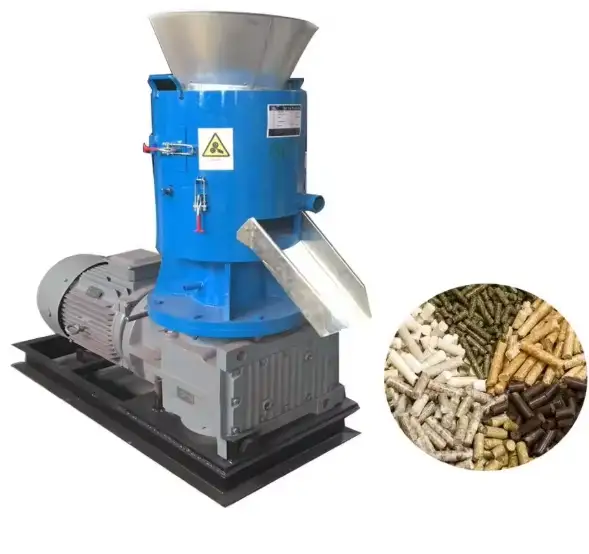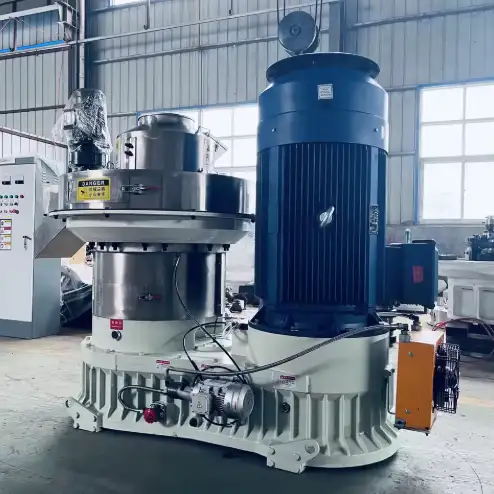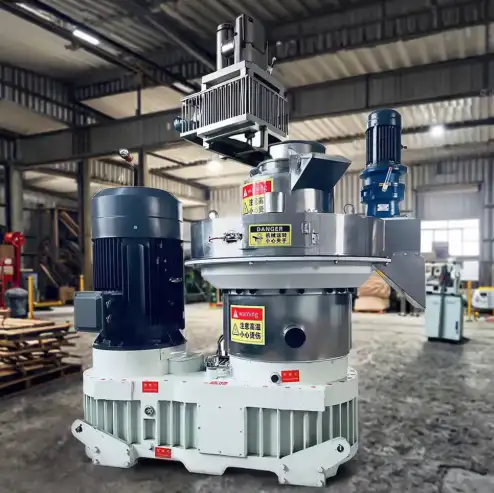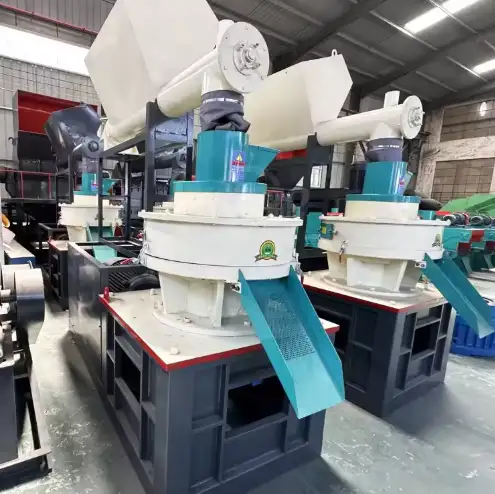

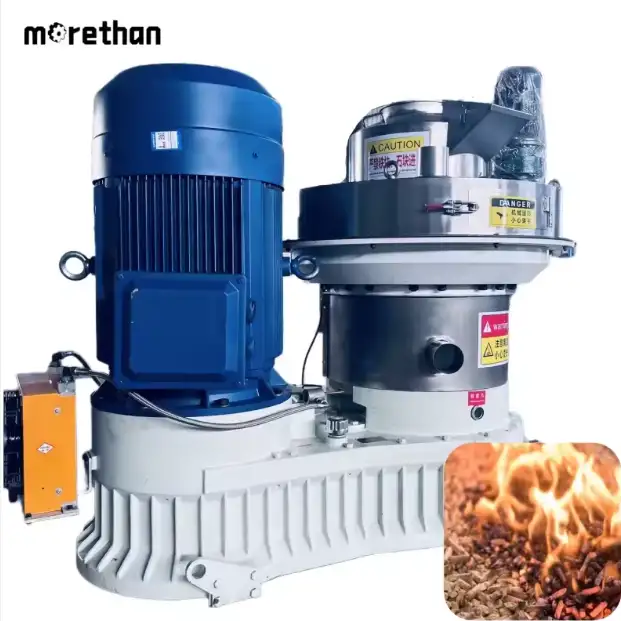
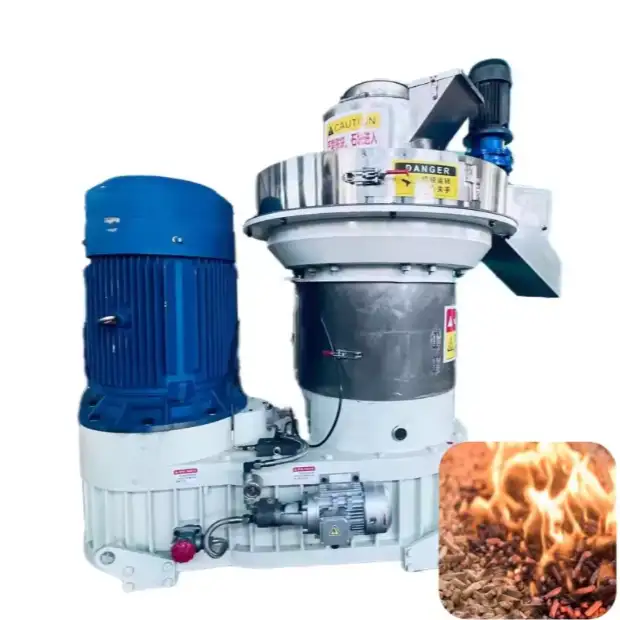
This ring-die pellet machine delivers reliable, high-capacity pellet production from rice husk, coconut husk, straw, grass, stalks, shaving and wood with throughput ranging from 200 to 5,000 kilograms per hour and a standard 380V industrial drive; it is best suited for continuous industrial lines that require steady pellet quality, long die life, and straightforward integration with pre- and post-processing equipment.
Key attributes
| Raw Material | Grass, Wood, Rice Husk, Wood Sawdust, Biomass, Straw,… | key selling points | High Productivity |
| core components | Bearing, Motor, Gear, Pump, PLC, Engine, Pressure Vessel… | voltage | 380 V |
| warranty | 2 Years | machinery test report | Provided |
| video outgoing-inspection | Provided | pellet diameter (mm) | 2 – 10 |
| output (kg/h) | 200 – 5000 | place of origin | Henan, China |
| motor power (kw) | 110 | weight (kg) | 7000 |
| dimension(1*w*h) | 1800+1500*1600 | Application | Make Biomass Pellets |
| Name | Biomass Wood Pellet Machine | Raw material | Sawdust\straw\rice Husk\wood Waste |
| Voltage | 380v Customerized | Usage | Making Wood Pellets Animal Feed Pellets |
| Type | Rind Die Biomass Pellet Mill | Capacity | 200-5000KG/H |
| After-sales Service Provided | 24 Hours Online Service | Pellet size | 2/4/6/8/10/12mm Customized |
| Product name | Wood Sawdust Pellet Biomass Wood Pellet Mill |
1. What this machine does and who benefits
This industrial ring-die pellet mill converts fibrous and granular biomass into dense fuel or bedding pellets. Customers that gain most are biomass fuel producers, agricultural cooperatives, integrated feed mills that handle crop residues, industrial boiler owners, and waste-to-energy projects that require steady, high-volume pellet output. The unit excels when continuous operation and consistent pellet dimensions are required for downstream automatic handling equipment.
2. Core components and operating principle
A modern horizontal ring-die pellet machine contains these main assemblies:
- Feeding system: screw or belt feeder that meters ground and dried material into the pelletizing chamber.
- Pelletizing chamber: ring die, paired rollers, die cover, and end plates where compression forms pellets.
- Drive train: high-power motor, gearbox or gear drive, coupling, and often a variable frequency motor controller for speed control.
- Cooling cutter: knife or cutter near the die exit to size pellets to target length.
- Control panel: electrical protection, overload detection, and control logic for automation.
Working principle summary: material is fed into the pellet chamber, forced through die holes by rotating rollers, compressed to form pellets that gain strength from frictional heat and lignin softening, then cut to length. Gear drives or heavy-duty bearings support continuous, high-torque operation.
3. Rated performance, power and electrical considerations
Typical published models cover capacities from roughly 200 kg/h up to 5,000 kg/h, matching small industrial lines through to medium-to-large plants. Standard line voltage for these models is industrial 380V three-phase; however single-phase or other voltages can be supplied by manufacturer on request for specific markets. Power draw depends on feedstock, moisture, die hole size, and throughput. Many OEMs recommend variable frequency drives to reduce current spikes at start and permit gentle ramp-up.
Key electrical notes
- Use a dedicated three-phase supply with proper overload protection.
- Install soft start or VFD for extended motor life and reduced electrical stress.
- Confirm local wiring standards and earthing before commissioning.
4. Raw material requirements and pre-processing recommendations
High pellet quality requires feedstock that meets particle size and moisture specifications. Typical guidelines:
- Particle size: 3–6 mm recommended after hammer milling.
- Moisture: 10–16% for most lignocellulosic materials; rice husk and coconut husk often need slightly lower moisture due to their silica or coarse fiber content.
- Impurities: remove stones, metals, plastics and sand to avoid die damage.
- Additives and binders: not essential when moisture and particle size are controlled, but small binder percentages may help with low-lignin crops.
Pre-processing chain usually: screening → drying → hammer milling → magnetic separation → buffering hopper. Proper pre-treatment increases throughput and prolongs die life.
5. Pellet quality: density, durability and size control
Quality metrics buyers monitor:
- Bulk density: higher density gives more energy per storage volume. Typical premium pellets hit 600–700 kg/m³ for woody feedstock.
- Durability: measured by drop/durability tests; good pellets exceed 90% durability by standard tests.
- Moisture in final pellet: usually below 10% for stable storage.
- Diameter and length: die hole diameter (commonly 6, 8, 10, 12 mm) determines pellet diameter; a cutter sets length.
Pellet density correlates with compression pressure in the die and pellet cooling time. Ring-die designs can deliver higher, more uniform density under continuous load.
6. Ring-die versus flat-die: decision factors
Both technologies remain in common use, but suitability differs by scale and product:
Ring-die strengths
- Better suited for continuous, high-volume production since ring dies balance wear and heat over a larger surface.
- Generally longer production runs with fewer die changes.
- Handles fibrous and mixed biomasses with more consistent pellet shape.
Flat-die strengths
- Lower capital cost and simpler maintenance for small operations.
- Easier die replacement for trials or multiple product sizes.
When to choose ring die
- If hourly throughput target exceeds a few hundred kilograms and continuous operation is required.
- If integration with large conveyors and silos is planned.
When to choose flat die
- For small workshops, pilot lines, or when capital cost must remain minimal.
Typical production line layout and peripherals
A commercial installation typically stages equipment in this sequence:
- Yard/storage for raw biomass
- Pre-cleaning and magnetic separation
- Dryer or drying silo with control for target moisture
- Hammer mill or grinder for consistent particle size
- Buffer hopper and metering feeder to pellet mill
- Pellet mill (ring-die) with cooling and length cutter
- Pellet cooler and screener to remove fines
- Packing machine and storage silos
Automation and instrumentation at each stage increase throughput predictability and reduce labor needs.
8. Energy use, throughput optimization and yield factors
Energy consumption per tonne varies with feedstock quality, moisture content and die geometry. Typical electrical energy use for modern ring-die lines ranges broadly from several dozen kWh per tonne up to 200 kWh per tonne under unfavorable conditions. Controlling moisture and particle size yields the best specific energy. Using gear drive and VFD permits steady torque delivery which improves compression efficiency and reduces power spikes.
Throughput drivers
- Finer grinding increases pellet surface contact but raises power draw.
- Correct moisture reduces internal friction thereby improving output.
- Balanced feeding prevents die bridging and uneven roller wear.
9. Materials, wear parts and spare parts planning
High-wear components and recommended materials:
- Ring die: typically alloy steel with surface hardening, replaceable and re-machinable.
- Roller shells: hardened steel; maintain roller concentricity.
- Bearings and seals: high-quality, properly lubricated bearings reduce downtime.
- Cutters and knives: keep spare set for quick changeouts.
Spare parts stocking recommendation for continuous operations:
- 1 spare die (critical), 2 spare roller shells, 1 set cutter knives, bearing set, gasket kit, basic electrical spares. Suppliers often supply wear-part kits tailored to model and feedstock.
10. Installation, commissioning and safety checklist
Mechanical
- Level and anchor foundation bolts.
- Align gearbox and motor shaft coupling precisely.
- Confirm correct ring die seating and roller clearance.
Electrical
- Verify motor voltage and phase rotation.
- Program overload protection and VFD parameters.
- Install emergency stop and interlocks on access doors.
Safety
- Provide guarding for rotating parts.
- Fit temperature sensors in bearing housings and the pelletizing chamber.
- Train operators on lockout/tagout procedures and hot-work rules.
11. Preventive maintenance plan and troubleshooting matrix
Daily
- Check feed hopper and magnetic separators for tramp metal.
- Inspect lubrication points and top up where needed.
- Monitor motor current for unexpected spikes.
Weekly
- Visual inspection of die and roller surface.
- Tighten electrical connections and check control panel status.
Monthly
- Measure die thickness and roller roundness.
- Replace oil in gearboxes if metal contamination appears.
Troubleshooting quick matrix
- Low throughput → check moisture high, oversized particles, or worn die.
- Excessive fines → check cutting blade condition or pellet cooling time.
- Motor overload trips → check feed rate surge or partial die blockage.
12. Environmental, storage and handling best practices
- Store dried pellets in cool, dry silos to prevent mold.
- Control dust with cyclone separators and bag filters to limit fugitive emissions.
- Use appropriate PPE when handling dusty feedstock to limit respiratory exposure.
Regulatory compliance varies by jurisdiction; for large plants, particulate control and noise mitigation are common permit requirements.
13. Commercial considerations: CAPEX, OPEX and ROI model
CAPEX drivers
- Mill size and configuration, die quality, automation level, and peripheral equipment.
OPEX drivers
- Electricity consumption, spare parts, labor, feedstock drying cost. High throughput systems typically achieve lower cost per tonne because fixed overhead spreads across volume.
ROI sketch
- Estimate pellet selling price per tonne, subtract variable cost per tonne to find contribution margin, then calculate payback given capital outlay. High utilization and contracted offtake accelerate payback. Use conservative feedstock cost and energy prices when modeling.
14. Comparative specification tables and example configurations
Table 1: Example model range and typical specs
| Model range | Throughput (kg/h) | Typical motor rating (kW) | Common die diameters (mm) | Typical application |
|---|---|---|---|---|
| Small ring model | 200–800 | 55–160 | 6, 8 | Small industrial pellet lines, demo plants. |
| Medium ring model | 800–2,000 | 160–315 | 8, 10 | Commercial pellet manufacturers, medium plants. |
| Large ring model | 2,000–5,000 | 315–630 | 10, 12 | Large biomass fuel plants and industrial customers. |
Table 2: Material suitability quick reference
| Feedstock | Typical pre-treatment | Suitability | Notes |
|---|---|---|---|
| Rice husk | Fine grinding, lower moisture | Good for fuel pellets | High silica content increases die wear; monitor wear rate. |
| Coconut husk | Grinding, binder possible | Moderate | Long fibers may need blending for consistency. |
| Straw/grass/stalk | Drying, hammer milling | Good | Low lignin crops may need higher compression or binders. |
| Wood shaving/sawdust | Drying, screening | Excellent | Best pellet density and energy content. |
Table 3: Maintenance spare parts checklist for continuous operation
| Item | Recommended stock |
|---|---|
| Ring die | 1 spare |
| Roller shell set | 2 sets |
| Bearings | 2 extra per main bearing position |
| Cutter blades | 3 sets |
| Gaskets & seals | 1 kit |
| Electrical fuses & contactors | Assortment |
15. Frequently asked questions
- What feed moisture is optimal for my biomass?
Most lignocellulosic materials perform best at 10–16% moisture. Lower moisture is often needed for rice husk and other high-silica residues. - Why choose ring die instead of flat die for this capacity range?
Ring-die design is engineered for continuous high throughput with longer service intervals and uniform pellet output. - How long does a ring die last?
Die life depends on material abrasiveness and maintenance. Typical life spans range from months to years; high-silica materials will shorten life. Plan spare die inventory for uninterrupted production. - Can the machine run on single-phase power?
Standard industrial models use three-phase 380V. Single-phase operation requires special motors or transformers and reduces available power. - What pellet sizes can be produced?
Common diameters are 6, 8, 10 and 12 mm. Length is adjustable with the cutter. Custom dies allow other sizes. - How to reduce pellet fines?
Ensure correct moisture, sharp cutter blades and adequate cooling time after pelleting. Use a good pellet cooler and screener. - Is a dryer required?
For most wet or variable feedstocks, a dryer improves throughput and reduces die wear. Some dry feedstocks might bypass drying if within moisture range. - How much electricity will it use?
Specific energy depends on feedstock and process conditions. Expect broad ranges; detailed energy audit recommended during commissioning. - What safety equipment should be installed?
Temperature sensors, emergency stops, proper guarding, dust extraction and operator training are essential. - How quickly can I switch die sizes?
Quick-release hoop dies reduce downtime. Plan for tooling changes with trained crew to minimize production loss.
Appendix: Quick selection checklist for buyers
- Confirm targeted hourly throughput and 24/7 duty rating.
- Check feedstock type, particle size plan and moisture control strategy.
- Ensure power supply matches motor rating and install VFD when in doubt.
- Request OEM spare-parts kit and wear-rate references for your primary feedstock.
- Ask for a factory acceptance test report showing pellet density and durability for a feedstock sample.