

A properly specified hammer mill is often the most cost-effective, flexible, and maintenance-manageable option for reducing wood and agricultural residues to particle sizes suitable for pelletizing, briquetting, or thermochemical conversion; when sized for feed characteristics, fitted with the correct rotor and screen, and paired with dust control and routine wear-part management, a hammer mill delivers predictable throughput, consistent particle distribution, and lowest total cost of ownership for small-to-medium biomass preprocessing lines.
1. What a hammer mill for biomass is and where it belongs in a processing line
A hammer mill is a size-reduction device that uses rapidly rotating hammers to impact and shear incoming material against a rigid surface and a perforated screen; for biomass, the mill’s role is preparatory — converting diverse residues such as wood chips, straw, shells, and stalks into a homogeneous fraction that meets the downstream requirements of a pelletizer, briquette press, gasifier, or furnace. Industrial hammer mills for biomass are frequently the standard auxiliary machine in small-to-medium pellet plants and are also used as a pre-crusher for biofuel feedstock.
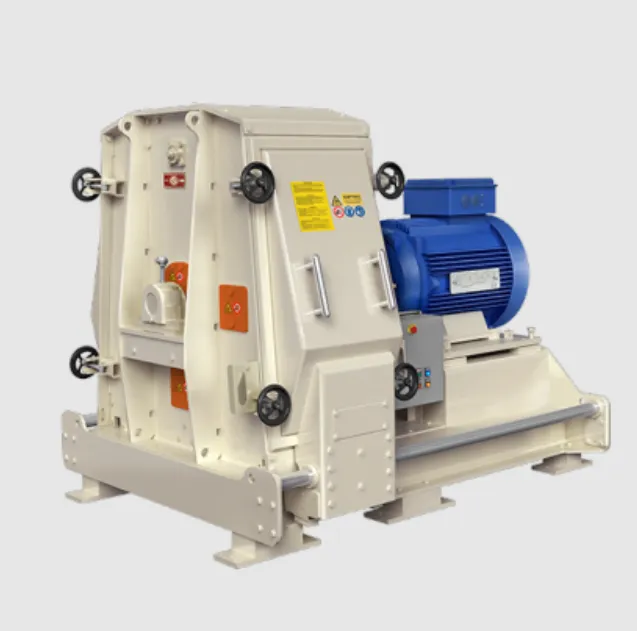
2. How hammer mills reduce biomass: mechanical principles and key components
Mechanics in brief
-
The rotor carries multiple hammers (single-piece or reversible inserts) that swing or are fixed to the rotor. When the rotor spins, hammers strike biomass at high speed, generating tensile and compressive stresses that fragment fibers and particles. Material is sized by passage through a screen or grid.
Primary components and their functions
-
Inlet/feeder: feeds material at controlled rate to avoid bridging.
-
Rotor: mass and diameter determine tip speed; higher tip speed increases breakage intensity.
-
Hammers: geometry and material affect impact energy and wear life.
-
Screens: control final top-size by aperture; mesh size strongly affects throughput and power.
-
Housing and anvil or grate: provides impact resistance and secondary crushing surfaces.
-
Drive system: electric motor, gearbox or diesel engine; power sizing is matched to expected load and desired throughput.
Key terms you will use repeatedly
-
Tip speed, screen aperture, specific energy (kWh/t), throughput (t/h), hammer configuration, and design wear coefficients.
3. Types and common configurations used for biomass
Common industrial styles and when to pick them
-
High-speed hammer mill (impact-style): best for fibrous materials and when a fine product is needed; typical for pellet and biofuel applications.
-
Low-speed hammer mill (crushing-style): heavier hammers, lower tip speed; better for brittle or woody biomass with large starting particles.
-
Hermetic/housed hammer mill: sealed housings for dust control and explosion mitigation in fine grinding applications. Useful when dust containment is critical.
-
Reversible hammer mills: hammers can be flipped to expose a fresh edge; cost-effective for long wear life.
-
Integrated-feed hammer mills: include feed conveyors, variable-speed drives, and automatic screens for continuous pellet lines.
Industrial models range from small bench or household units (200–500 kg/h) up to heavy-duty mills rated 8–20 t/h or more. Choose based on downstream requirement and plant scale.
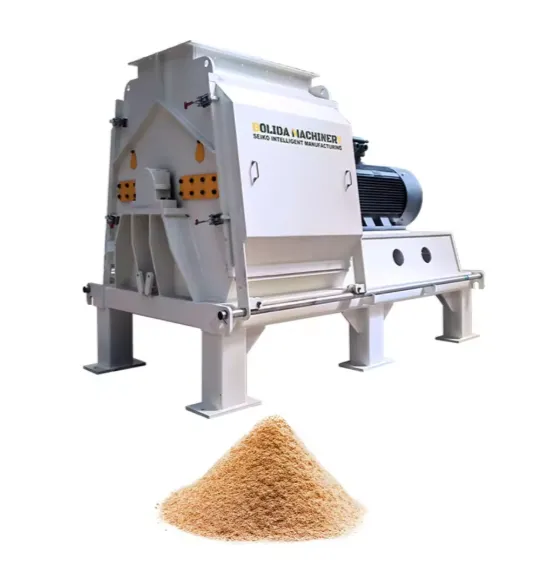
4. Biomass feedstock characteristics that control performance
The five feed attributes that matter most
-
Input particle size and shape: Long stalks and chips must be pre-chipped or fed with controlled orientation. Maximum recommended inlet length often specified by manufacturers (e.g., 80–100 mm for many industrial mills).
-
Moisture content: Moisture influences throughput and energy. Very wet feed (above ~20–25% for many wood types) reduces impact breakage efficiency and plugs screens; extremely dry and friable feed can produce excess fines and dust. Performance curves from suppliers show throughput falls with increasing moisture.
-
Bulk density: Low-density fluffy materials require different feeding and precompression strategies compared with dense shells or bark.
-
Hardness and abrasiveness: Coconut shell and nut shells are highly abrasive and increase hammer and screen wear; select hardened wear parts accordingly.
-
Contaminants (metal, stone): Foreign materials damage hammers and screens. Magnetic separators, tramp metal catchers, and careful feed inspection are essential in commercial lines.
5. Performance parameters and sample specification tables
Below are representative performance ranges and a sample specification matrix to use as a baseline when sizing or writing procurement specifications.
Key performance metrics explained
-
Capacity: measured in kg/h or t/h; depends on feed properties, screen aperture, rotor speed, and motor power.
-
Screen aperture: determines maximum output particle size and the distribution of fines.
-
Power draw: electrical power required (kW).
-
Specific energy: kWh per tonne — useful for techno-economic models.
-
Hammer tip speed: calculated from rotor diameter and RPM; relates to impact energy.
Representative performance table (industrial mid-range mills)
| Model range | Motor power (kW) | Typical capacity (t/h) | Screen aperture (mm) | Typical feed size max (mm) | Typical application |
|---|---|---|---|---|---|
| Small (household/bench) | 5–15 | 0.2–0.8 | 3–6 | 10–30 | Home pellet stoves, small labs. |
| Medium (small plant) | 22–55 | 0.5–2.5 | 2–6 | 20–80 | Small pellet lines, feed mills. |
| Large (industrial) | 75–150 | 3–16 | 1–8 | 100* | Large pellet/briquette lines, pre-grinding. |
* Maximum feed length and diameter differ by design; always confirm with OEM.
Example specification (template language for RFQ)
-
Duty: Continuous 24/7 or intermittent, specify expected hours.
-
Feedstock: list species and moisture range.
-
Design capacity: X t/h at Y% moisture with Z mm screen aperture.
-
Guaranteed power draw: ≤ P kW at rated load.
-
Wear components: hammer material (e.g., martensitic steel or tungsten overlays), replaceable liners, reversible hammer design.
-
Safety: interlocks, vibration sensors, rotor imbalance detection, and dust suppression.
-
Certifications: CE, ISO, ATEX (if required for hazardous dust).
6. Design and selection checklist
A practical checklist to choose the right mill
-
Define end-product size and acceptable fines: this sets screen aperture.
-
Establish feed variability: if feed is variable, select a mill tolerant of a range of moisture and contaminants.
-
Match motor power to feed hardness and desired throughput: oversize slightly to avoid overloads.
-
Decide hammer configuration: reversible hammers, welded or bolted inserts, and number of hammers per row affect wear life and maintenance.
-
Plan for dust control: include cyclones or fabric filters and, for fine dust, consider hermetic mill housings.
-
Accessibility for maintenance: quick-change screens, easily replaced hammers, and simple rotor removal reduce downtime.
-
Spare parts strategy: keep a planned inventory: extra screen(s), hammers, bearings, rotor bolts.
-
Energy efficiency targets: use specific energy (kWh/t) benchmarks; if energy is a major cost, compare with roller mills or shredders for coarse pre-reduction.
7. Installation, integration, and material handling tips for pellet and briquette lines
Conveying and feeding
-
Use a controlled metering conveyor or variable-speed screw to ensure even feed to the mill. Overfeeding creates bridging and motor stalls; underfeeding wastes capacity. Vibratory feeders or belt conveyors with variable frequency drive (VFD) meters work well.
Dust management and airflows
-
Match mill discharge to a cyclone or bag filter; dust containment reduces wear and improves safety. For fine product, a positive-pressure dust collector ahead of storage will reduce loss and risk. Systems with hermetic housings help when dust explosions are a hazard.
Downstream compatibility
-
Coordinate screen aperture with pellet mill die or briquette press inlet size to prevent regrinding or excessive fines. Many pelletizers specify <3 mm top size for optimal densification.
Layout considerations
-
Allow service access on both sides of the mill for screen and hammer replacement. Include space for spare parts and a safe access platform.
8. Wear, maintenance, and spare-part strategies to maximize uptime
Wear patterns and materials
-
Hammers, screens, and liners are primary wear parts. For abrasive feeds use hardened martensitic steels, chromium carbide overlays, or tungsten carbide inserts. Reversible hammers double replacement intervals for asymmetric wear.
Routine maintenance schedule (practical example)
-
Daily: check feed rate, inspect for unusual noise and vibration, clear small blockages.
-
Weekly: inspect screens and hammer edges for wear; tighten rotor bolts.
-
Monthly: check bearings, gearbox oil levels, and alignment.
-
Quarterly: measure hammer thickness and schedule replacements before reaching OEM minimum dimensions.
-
Annually: major inspection, rotor balancing, change gear oil, full inspection of safety systems.
Stocking spares
-
Minimum recommended spares: one full set of screens, one spare rotor bolt kit, and hammers to cover two replacement cycles for critical machines.
Monitoring and predictive maintenance
-
Vibration sensors and power-draw logging help indicate developing imbalance or worn hammers. Many modern installations add simple PLC alarms tied to power spikes or vibration thresholds.
9. Safety, dust control, and emission considerations
Dust explosion risk and control
-
Biomass dust can be combustible. Control strategies include minimizing dust leaks, using hermetic housings or accurate airflow management, incorporating explosion vents or suppression systems where regulations or risk assessments require, and following ATEX/NFPA guidance when applicable.
Operator safety
-
Interlocked guards, rotor lockout procedures for maintenance, and clear SOPs for screen changes reduce incidents. Regular training and permit-to-work systems are recommended.
Emissions and local regulations
-
For installations feeding furnaces or boilers, set particulate emission limits and implement appropriate filtration (cyclone + baghouse or ESP), plus ash handling and disposal policies.
10. Troubleshooting: common operational problems and fixes
Problem: Excess fines and dust
-
Probable causes: screen too fine, high tip speed, brittle feedstock, or improper moisture. Fixes: increase screen size slightly, lower rotor speed if adjustable, precondition feed moisture, or stage crushing.
Problem: Low throughput
-
Probable causes: plugged screens, excessive moisture, wrong hammer configuration, or underpowered motor. Fixes: clean or replace screen, dry feed to recommended range, fit coarser hammers, check motor capacity.
Problem: Rapid wear of hammers and screens
-
Probable causes: abrasive feed (shells), tramp metal, or wrong hammer material. Fixes: change to harder wear material, add metal detectors/separators, reduce feed contaminants.
Problem: Vibration and noise
-
Probable causes: rotor imbalance, loose bolts, or bearing failure. Fixes: balance rotor, torque bolts to spec, replace bearings, review rotor keying.
11. Comparative considerations: hammer mill vs roller mill vs impact crusher vs pin mill
Short comparative summary
-
Hammer mill: versatile, tolerates variable feed, good for fibrous biomass, adjustable particle size with screens, relatively moderate capital cost. Best for small-to-medium pellet/briquette lines.
-
Roller mill: produces narrower particle distribution with lower fines, more energy-efficient for some materials, higher capital and maintenance demand for fibrous materials.
-
Impact crusher: suited for primary crushing of large woody pieces and rock-like materials; less suited for fine particle production for pelletizing.
-
Pin mill: excels at fine, uniform powders in chemical or pharmaceutical contexts; less tolerant of long, fibrous feed.
Choose based on desired particle size distribution, feed characteristics, energy cost, and maintenance capabilities.
12. Environmental, regulatory, and lifecycle considerations
Lifecycle assessment basics
-
Grinding consumes electrical energy; compare specific energy costs per tonne between mill types. Consider lifecycle emissions: sourcing electricity, enabling densification (which reduces transport emissions), and replacing fossil fuel offsets if biomass fuels are displacing coal. Designs that reduce fines reduce transport losses and local PM emissions.
Regulatory drivers
-
Local air quality rules may require particulate capture. Workplace exposure limits for wood and agricultural dusts may require local exhaust ventilation and PPE policies.
End-of-life
-
Plan for recyclable materials in wear parts and responsible disposal of used oils and worn linings.
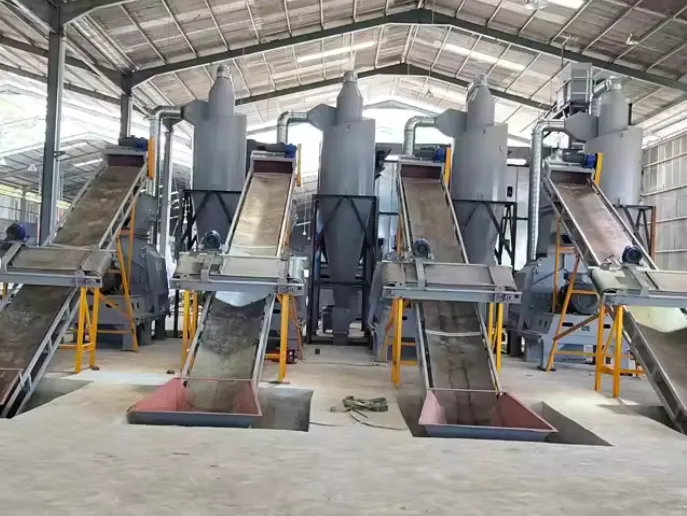
13. Case examples and short buyer’s checklist
Short illustrative case
-
Small rural pellet plant: feed = mixed hardwood chips and straw, target = 1 t/h pellets. Selected a 37 kW hammer mill with 3 mm screen, reversible hammers with tungsten overlays for shell content, cyclone + baghouse, and a VFD-controlled feed conveyor. Outcome: stable throughput with 3–6% fines and predictable die wear.
Buyer’s quick checklist (top 10 items)
-
Confirm feed species and moisture range.
-
Define guaranteed throughput at target screen aperture.
-
Ask for guaranteed power draw and specific energy at rated capacity.
-
Check material and hardness of hammers and screens.
-
Verify maintainability: screen change time, rotor removal method.
-
Inspect safety features: interlocks and access guards.
-
Confirm dust control and explosion mitigation options.
-
Ask for references with similar feedstock.
-
Confirm warranty and spare parts availability.
-
Negotiate spare-part kit and service contracts.
14. Charts and data visualizations (textual representations)
Below are three practical charts expressed as short tables or conceptual plots that help selection.
Chart A. Typical effect of moisture on throughput (conceptual)
| Moisture content (wb %) | Relative throughput (%) |
|---|---|
| 8 | 100 |
| 12 | 94 |
| 18 | 78 |
| 25 | 60 |
| Note: numbers are illustrative; check OEM curves for precise values for your feed. Moisture beyond ~20–25% commonly reduces throughput and increases plugging risk. |
Chart B. Particle size distribution shift with screen aperture
| Screen aperture (mm) | Mode particle size (mm) | Fraction <3 mm (%) |
|---|---|---|
| 8 | 6–10 | 10–20 |
| 4 | 2–6 | 30–50 |
| 2 | 0.5–3 | 60–85 |
| Selecting the smallest practical aperture reduces variability in pellet die feeding but increases power and wear. |
Chart C. Typical specific energy range for hammer mills (illustrative)
| Feed type | Specific energy (kWh/t) |
|---|---|
| Softwood chips | 25–45 |
| Harder shells (nut) | 45–90 |
| Mixed straw | 30–60 |
| Always validate with measurement on your feed; these numbers are starting points. |
15. FAQs
-
What is the best screen size for biomass intended for pellet mills?
For most pellet dies the recommended top-size is below 3 mm to ensure uniform feeding and reduce die wear. For larger briquette presses, 3–6 mm is often acceptable. Confirm with your downstream equipment supplier. -
How does moisture content affect hammer mill operation?
Higher moisture generally reduces efficiency of impact breakage, slows throughput, increases agglomeration and plugging risk, and can increase fines if feed becomes sticky. Aim for the moisture window recommended by the pellet or briquette equipment manufacturer. -
How often should hammers and screens be inspected or replaced?
Inspect daily or weekly depending on hours and abrasiveness. Replace when hammers reach the OEM minimum thickness or screens show signs of enlarged apertures. Many plants schedule monthly checks for high-use machines. -
Can hammer mills handle mixed feedstock?
Yes; mills tolerate variability better than many other mills, but design for the heaviest duty component (e.g., abrasive shells). Consider staged feeding or pre-sorting to protect wear parts. -
Are hammer mills energy efficient?
Energy efficiency depends on particle-size objective and feed type. For coarse pre-reduction they are competitive, but for narrow, fine distributions specialized mills (pin mills, roller mills) can be more efficient per tonne. -
What safety features are essential?
Rotor lockouts, interlocked guards, vibration sensors, tramp metal detection, and dust control are core elements. For combustible dust environments, explosion venting or suppression and hermetic housings may be required. -
How to reduce screen plugging?
Keep feed within recommended moisture range, use proper feeding rates, select slightly larger aperture or stepped screening, and consider pre-drying or pre-conditioning. -
What hammer materials last longest for abrasive shells?
Hardened martensitic steels with chromium carbide overlays or carbide-tipped inserts significantly extend life versus plain carbon steel. Balance cost versus replacement frequency. -
Can hammer mills be used for fine powder production?
Yes, with fine screens and high tip speeds, but dust control and explosion mitigation must be addressed. For ultra-fine powders, pin mills or specialized classifiers may be preferable. -
How to size a hammer mill for a planned throughput?
Start with desired t/h at target screen aperture and feed moisture. Use supplier performance curves for similar feed. Add a safety margin (often 10–25%) to motor power to avoid overloads when feed varies. Request OEM test data with your real feed when possible.
16. How this content was informed and why it’s different
This article distills operational practice from commercial OEM data, industrial maintenance guidance, and peer-reviewed observations about milling biomass. Sources were inspected to extract typical capacity ranges, maintenance cycles, and safety considerations and then expanded with practical checklists, troubleshooting flows, and lifecycle prompts that are often omitted in product pages. For readers seeking a converter-grade implementation, the emphasis was placed on matching the mill to feed behavior, not merely quoting horsepower.
Key source anchors used while preparing this resource include OEM product pages and technical primers on hammer mill function, maintenance guidance from industry magazines, and academic studies on milling energy and particle behavior. Representative sources consulted include GEMCO, Schutte Hammermill industry summaries, equipment catalogues, and biomass processing analyses.
17. Short procurement-ready specification (copy/paste)
-
Item: Biomass Hammer Mill, model: [OEM model].
-
Duty: Continuous/Intermittent, X hours per day.
-
Feedstock: [list species], moisture range: X–Y% (wet basis).
-
Capacity: Guaranteed X t/h at Y% moisture and Z mm screen aperture.
-
Drive: Electric motor, rated P kW, 50/60 Hz, includes VFD.
-
Rotor: diameter __ mm, tip speed __ m/s at rated RPM.
-
Hammers: reversible, alloy/matrix material __, minimum thickness __ mm.
-
Screen: perforated plate, 3 mm aperture standard; two spare screens included.
-
Dust control: integrated cyclone and baghouse with <X mg/Nm3 guarantee.
-
Safety: interlocks, rotor lock, vibration monitor, CE/ATEX compliance as required.
-
Warranty: 12 months on parts and workmanship.
-
Spare kit: one full set of screens, spare hammer set, rotor bolt kit.
-
Delivery: CIF or EXW, lead time X weeks.
18. Final practical recommendations
-
Always pilot test on representative feed before final selection. Real-world feed variability often dictates machine wear and uptime more than theoretical capacity numbers.
-
Implement a spare-parts policy and a monitoring plan (simple vibration + power logging) from day one.
-
Prioritize safety and dust handling in the contract to avoid expensive retrofits.
-
Demand OEM performance guarantees on kWh/t and throughput at your specified moisture and screen aperture.