

India’s biomass energy sector is rapidly expanding, fueled by the demand for sustainable fuel in Punjab’s agricultural belts and Gujarat’s industrial hubs. Lanson stands at the forefront of biomass pellet machine manufacturers in India, providing high-performance pelletizing technology designed to convert agricultural waste—such as rice husk, wheat straw, and sawdust—into high-density energy pellets.
Our machines are engineered to meet the unique challenges of the Indian climate and raw materials. By integrating high-purity refractory components and precision-engineered dies, Lanson ensures that your pellet production line operates with maximum uptime and minimal energy consumption. Whether you are a small-scale entrepreneur or a large-scale power plant supplier, our biomass pelletizers offer the durability and efficiency required for the Indian market.
Why India Has Become a Global Hub for Biomass Pellet Machine Manufacturing
Over the past decade, India’s manufacturing sector has matured significantly in the biomass energy equipment space. We have seen this transformation firsthand, watching small regional fabricators evolve into internationally exporting manufacturers with dedicated R&D labs, quality control departments, and overseas service networks.
Several structural factors drive India’s competitiveness in this sector:
Abundant Engineering Talent: India produces over 1.5 million engineering graduates annually. Mechanical engineering disciplines specifically related to agricultural machinery, process equipment, and industrial drives are well-represented. Biomass pellet machine manufacturing draws directly from this talent pool, particularly for die design, gearbox engineering, and automation integration.
Lower Labor and Overhead Costs: A skilled machinist in India earns roughly one-fifth of what a counterpart in Germany earns. This structural cost advantage allows Indian manufacturers to price their machines competitively while maintaining acceptable quality margins.
Strong Agricultural Economy: India’s agricultural output generates massive quantities of biomass residue — rice husk, wheat straw, sugarcane bagasse, cotton stalks, and more. This domestic supply of raw material has pushed domestic demand for pellet machines, which in turn has pushed manufacturers to refine their technology over time.
Government Policy Support: India’s National Bioenergy Programme and state-level renewable energy incentives have created a sustained domestic market. Manufacturers supplying this market have been pressured to improve reliability and output quality, raising the baseline standard across the industry.
Established Export Infrastructure: Cities like Rajkot, Ludhiana, Coimbatore, and Ahmedabad have established logistics corridors for heavy machinery export. Freight-on-board (FOB) pricing, pre-shipment inspection facilities, and export financing options are all accessible.
The result is an ecosystem where buyers — whether they are energy companies in Europe, agricultural processors in Southeast Asia, or project developers in Africa — can access biomass pellet machines that meet international performance benchmarks at prices that fit realistic project budgets.
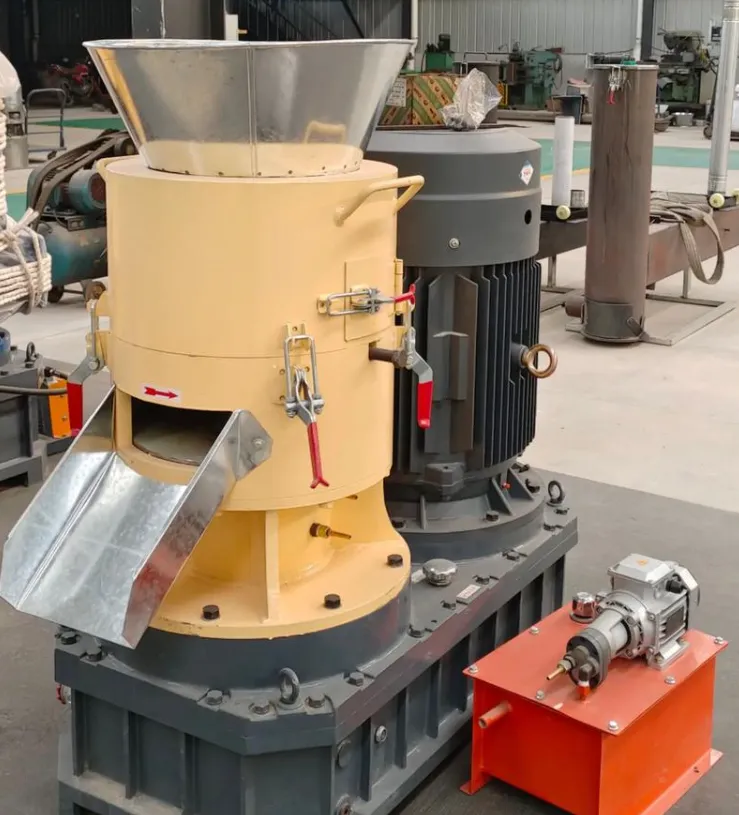
What Is a Biomass Pellet Machine and How Does It Work?
A biomass pellet machine, also called a pellet mill or pellet press, is a mechanical device that compresses loose, fibrous organic material into dense, uniform cylindrical pellets. The output pellets are used as solid biofuel, animal feed, or organic fertilizer depending on the feedstock and die configuration.
Core Working Principle
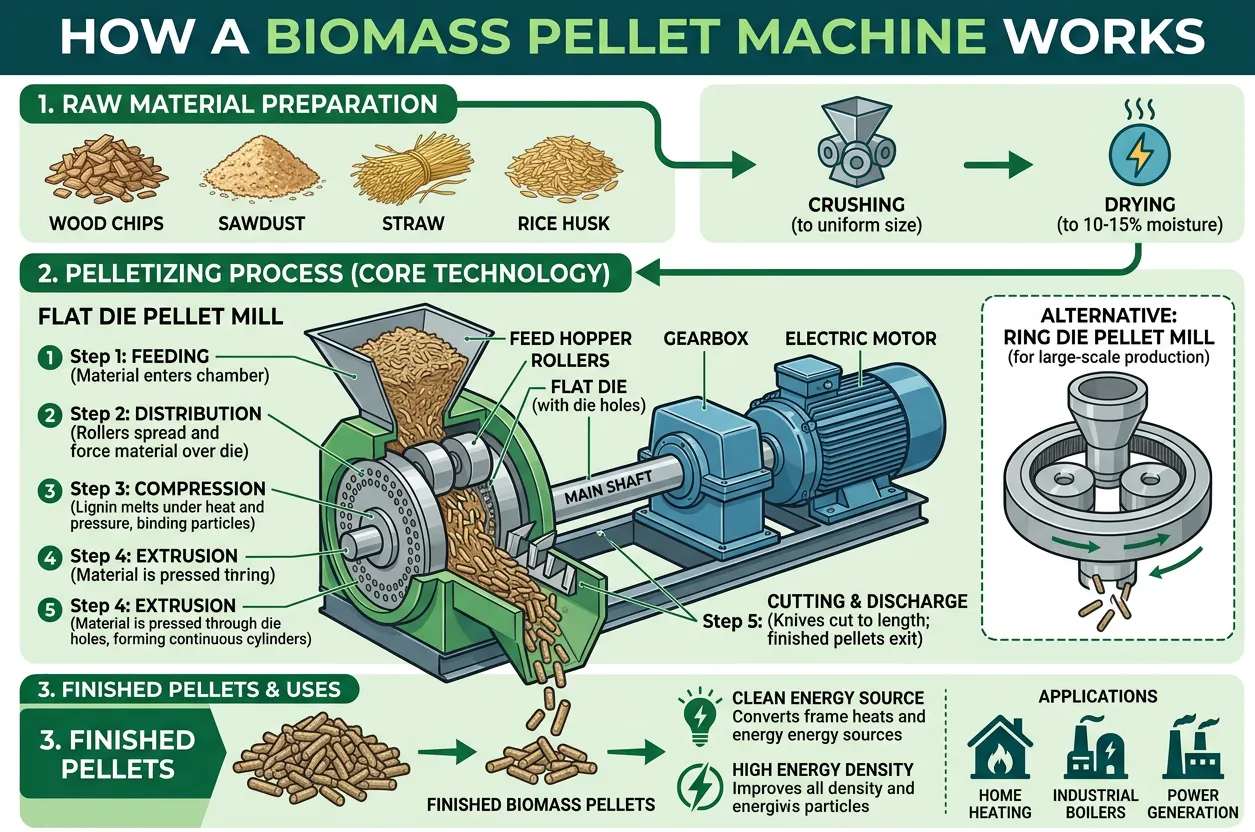
The core mechanism in most pellet machines involves a rotating die and one or more rollers. Here is the sequence:
- Feeding: Raw biomass material (ground to 3–5mm particle size, moisture content 10–15%) is fed into the pelletizing chamber by a screw conveyor or gravity chute.
- Compression: The rollers press the biomass into the die holes with high mechanical force. Friction and pressure cause the temperature inside the die holes to rise to 80–120°C.
- Binding: Natural lignin in the biomass softens at elevated temperatures and acts as a binder, fusing particles together without any chemical additive.
- Extrusion: The compressed material is extruded through the die holes and cut by fixed or rotating knives to produce pellets of consistent length (typically 10–30mm).
- Cooling: Hot pellets exit at 70–80°C and are passed through a counter-flow cooler to reduce temperature to near-ambient and harden the outer surface.
- Screening and Packaging: Fine particles (fines) are screened out and recycled. Finished pellets are bagged or loaded into bulk storage.
Flat Die vs. Ring Die: The Fundamental Design Split
| Feature | Flat Die Pellet Machine | Ring Die Pellet Machine |
|---|---|---|
| Die Orientation | Horizontal flat plate | Vertical cylindrical ring |
| Capacity Range | 50–800 kg/h | 500 kg/h – 10+ tons/h |
| Best For | Small farms, pilot projects | Industrial and commercial plants |
| Power Consumption | Lower per unit | Higher but more efficient at scale |
| Die Replacement Cost | Lower | Higher |
| Maintenance Complexity | Simple | Moderate to complex |
| Typical Indian Price Range | USD 800 – USD 12,000 | USD 15,000 – USD 180,000 |
We consistently advise buyers processing under 1 ton per hour to start with flat die machines if budget is constrained. For commercial pellet plants targeting 2+ tons per hour, ring die machines deliver better pellet density, consistency, and long-term per-unit cost efficiency.
Types of Biomass Pellet Machines Made in India
Indian manufacturers produce the full range of pellet machine types, covering everything from small-scale portable units to complete industrial pellet production lines. Understanding each type prevents mismatched procurement decisions.
Small-Scale Flat Die Pellet Mills (50–500 kg/h)
These machines are widely manufactured in Punjab, Haryana, and Gujarat. They are often PTO-driven (powered by tractor) or electrically driven (5–22 kW motor). Common applications include:
- On-farm biomass processing.
- Small cooperatives producing fuel pellets for local sale.
- Biochar and compost pellet production.
- Livestock feed pellet manufacturing in rural settings.
Indian manufacturers in this segment include many Rajkot-based engineering workshops that have standardized components and can ship within 2–4 weeks of order.
Medium-Scale Ring Die Pellet Mills (500 kg/h – 3 tons/h)
This is the most competitive segment in Indian manufacturing. Machines in this range are typically powered by 37–110 kW electric motors and are designed for dedicated pellet fuel production facilities, agro-processing units, and biomass energy co-ops.
Key design features from Indian manufacturers at this scale:
- Stainless steel conditioning chamber with steam injection ports.
- Alloy steel dies (x46Cr13 or equivalent) with multiple compression ratios available.
- Automatic lubrication systems for roller bearings.
- VFD (variable frequency drive) integration for energy savings.
- Safety clutches to protect gearbox during foreign material ingestion.
Industrial Ring Die Pellet Lines (3–10+ tons/h)
Complete pellet production lines at this scale are assembled by specialized turnkey manufacturers in Ahmedabad, Pune, and Chennai. These systems include:
- Primary shredder or hammer mill for raw material size reduction.
- Rotary drum dryer (if feedstock moisture exceeds 20%).
- Main pellet press with ring die.
- Counter-flow cooler.
- Vibrating screen classifier.
- Pellet bagging or bulk loading system.
- Centralized dust collection.
We have evaluated several complete lines offered by Indian manufacturers for international project developers. When properly specified and quality-controlled, these lines perform comparably to equivalent Chinese systems at similar or lower cost, and in some cases incorporate better-quality gearboxes and dies.
Biomass Briquette Machines (Alternative Format)
Technically distinct from pellet machines, briquette presses are also produced by many Indian pellet machine manufacturers and are worth mentioning since some buyers conflate the two. Briquettes are larger-diameter compressed fuel blocks (50–90mm diameter) produced without a die and roller system. They suit high-moisture or coarser biomass streams where pellet production would require expensive pre-processing.
Key Raw Materials Processed by Indian-Made Pellet Machines
India’s diversity of agricultural output means Indian pellet machine manufacturers have extensive experience engineering machines for a wider variety of feedstocks than most European or North American manufacturers.
| Feedstock | Bulk Density (kg/m³) | Moisture Challenge | Pellet Output Quality | Common Indian Application |
|---|---|---|---|---|
| Rice Husk | 90–150 | Low (5–12%) | Medium density | Power plant fuel, heating |
| Wheat Straw | 40–80 | Variable | Good with conditioning | Biomass energy export |
| Sugarcane Bagasse | 60–120 | High (40–55%) | Requires drying | Paper, energy, feed |
| Cotton Stalks | 80–130 | Low to moderate | Good | Rural fuel pellet production |
| Wood Sawdust | 150–250 | Variable | Excellent | Premium fuel pellets for export |
| Bamboo Dust | 200–280 | Low | Very good | Export grade pellets |
| Groundnut Shells | 200–280 | Low | Good | Local bioenergy use |
| Jute Sticks | 100–160 | Moderate | Good | Eastern India biomass plants |
| Corn Cobs | 120–200 | Moderate | Good | North India agri-biomass |
| Municipal Green Waste | Variable | High | Requires pre-processing | Urban biomass pilot projects |
Indian manufacturers who have been working with these diverse feedstocks for years have developed feedstock-specific die configurations, compression ratios, and conditioning approaches that a buyer importing from less experienced markets simply cannot access.
Top Regions and Industrial Clusters for Pellet Machine Manufacturing in India
Rajkot, Gujarat
Rajkot is arguably the most concentrated hub for pellet and briquette machine manufacturing in India. The city has a decades-old tradition of engineering and machinery manufacturing. Hundreds of small to medium-sized manufacturers operate here, ranging from rudimentary fabricators to well-organized exporters. Price competition is intense, which benefits buyers, but quality variation is also significant, which means due diligence is essential.
Ludhiana, Punjab
Punjab’s agricultural economy has driven strong local demand for biomass processing equipment. Ludhiana manufacturers tend to specialize in flat die machines and PTO-driven units suited for agricultural applications. Several companies here have expanded into ring die territory as domestic bioenergy policies have scaled up.
Ahmedabad, Gujarat
Larger-scale turnkey biomass pellet plant manufacturers are concentrated here. Companies in Ahmedabad often have dedicated design engineering teams and can produce custom solutions for international buyers. Export documentation and logistics management tends to be more sophisticated here than in smaller clusters.
Coimbatore, Tamil Nadu
Coimbatore’s engineering cluster is known for high-quality machining and manufacturing processes. Several pellet machine manufacturers here have adopted lean manufacturing and quality management systems (ISO 9001), making them attractive for buyers with strict quality requirements.
Pune, Maharashtra
Pune’s proximity to automotive and heavy industry has produced a generation of engineers comfortable with precision manufacturing. Biomass pellet machine manufacturers in Pune tend to produce more mechanically refined machines than some lower-cost competitors, though pricing reflects this.
Delhi NCR (Noida, Faridabad)
The Delhi NCR region has a growing cluster of biomass machinery manufacturers serving both domestic and export markets, with good logistics access for both ocean and air freight.
How to Evaluate Indian Biomass Pellet Machine Manufacturers
Choosing the wrong supplier is one of the most expensive mistakes a buyer can make in capital equipment procurement. We have seen projects derailed by poor supplier selection. Here is a practical evaluation framework.
Step 1: Verify Manufacturing vs. Trading
Many companies marketing themselves as “manufacturers” in India are actually trading companies reselling machines made by others. This is not inherently problematic, but it affects pricing, customization capability, and after-sales support. Request:
- Factory photos showing production floor with CNC machines, welding stations, and assembly areas.
- Video call factory tour (acceptable alternative to in-person visit for initial screening).
- Original equipment manufacturer (OEM) documentation.
Step 2: Check Export Track Record
A manufacturer with verifiable export experience to your target region is significantly lower risk. Request:
- Export bill records or commercial invoices (redacted for confidentiality is acceptable).
- References from existing international customers.
- Country-specific compliance documentation (CE mark for Europe, UL for USA, etc.)
Step 3: Assess Technical Engineering Capability
The quality of a pellet machine is largely determined by die and roller engineering. Ask:
- What steel grade is used for the die and rollers?
- What compression ratio options are available for your specific feedstock?
- Do they have in-house heat treatment capability for dies?
- What is their die replacement lead time?
Step 4: Evaluate After-Sales Support
Post-purchase support is where many Indian manufacturers fall short. Evaluate:
- Spare parts availability and delivery time to your country.
- Availability of remote technical support (video call, WhatsApp, email response time).
- Whether they have local service partners or technicians in your region.
- Training availability (on-site or video-based commissioning support).
Step 5: Conduct Factory Audit or Third-Party Inspection
For orders above USD 20,000, we strongly recommend a pre-shipment inspection by a recognized third-party agency (SGS, Bureau Veritas, TUV, or equivalent). This inspection should cover:
- Dimensional accuracy of major components.
- Electrical safety compliance.
- Operational performance test (the machine should run with your feedstock or equivalent material under real load conditions).
- Packaging and shipping preparation standards.
Technical Specifications Buyers Must Understand Before Purchasing
Procurement decisions based solely on price without understanding technical specifications lead to operational disappointment. The following specifications are critical.
Die Specifications
| Parameter | What to Look For | Why It Matters |
|---|---|---|
| Die Material | x46Cr13, 42CrMo, or stainless 316 | Determines die life and pellet surface finish |
| Compression Ratio (L/D) | 4:1 to 12:1 depending on feedstock | Higher ratios for harder, denser pellets |
| Hole Diameter | 6mm, 8mm, 10mm, 12mm | Determines pellet diameter |
| Number of Holes | Varies by die diameter | Affects output capacity |
| Heat Treatment | Quenching + tempering to 55–60 HRC | Extends die service life |
Roller Specifications
- Material: Alloy steel with surface hardening.
- Roller-to-die clearance: 0.1–0.3mm (critical for wear management).
- Bearing type: Tapered roller bearings preferred over ball bearings for durability.
- Lubrication: Automatic centralized lubrication preferred over manual greasing.
Motor and Drive System
| Machine Capacity | Recommended Motor Power | Drive Type |
|---|---|---|
| 100–300 kg/h | 15–22 kW | Direct drive or belt drive |
| 300–800 kg/h | 22–55 kW | Belt drive with flywheel |
| 800 kg/h – 2 t/h | 55–90 kW | Gearbox drive |
| 2–5 t/h | 90–160 kW | Heavy-duty gearbox + VFD |
| 5–10 t/h | 160–315 kW | Industrial gearbox + VFD |
Pellet Quality Output Standards
For fuel pellet applications, verify the machine can produce pellets meeting ENplus A1 or equivalent standards:
- Diameter: 6mm or 8mm (±0.5mm tolerance)
- Length: 3.15–40mm
- Moisture content: Below 10%
- Mechanical durability: Above 97.5%
- Ash content: Below 0.7% (for wood), below 1.5% (for agricultural residues)
- Bulk density: Above 600 kg/m³
Pricing Breakdown: What Indian Biomass Pellet Machines Actually Cost
Price transparency is something we believe strongly in, because buyers who understand realistic pricing are better protected from inflated quotes and unrealistic “cheap” offers that signal quality compromises.
| Machine Type | Capacity | Price Range (Ex-Works India) | Motor Power |
|---|---|---|---|
| Flat Die Pellet Mill (small) | 50–150 kg/h | USD 800 – USD 3,500 | 7.5–15 kW |
| Flat Die Pellet Mill (medium) | 150–500 kg/h | USD 3,500 – USD 10,000 | 15–30 kW |
| Ring Die Pellet Mill (small industrial) | 500 kg/h – 1.5 t/h | USD 15,000 – USD 45,000 | 37–75 kW |
| Ring Die Pellet Mill (industrial) | 1.5–4 t/h | USD 45,000 – USD 120,000 | 75–160 kW |
| Ring Die Pellet Mill (large industrial) | 4–8 t/h | USD 100,000 – USD 200,000 | 160–315 kW |
| Complete Pellet Production Line | 1–5 t/h | USD 80,000 – USD 350,000 | Full system |
| Complete Pellet Production Line | 5–10 t/h | USD 300,000 – USD 700,000 | Full system |
Additional Cost Factors to Budget For:
- Ocean freight: USD 1,500–8,000 depending on destination and machine size
- Pre-shipment inspection: USD 400–1,500
- Import duties: Varies by country (0–25% typically)
- On-site installation and commissioning: USD 2,000–10,000 if required
- Spare parts kit (initial): 5–10% of machine cost recommended
- Annual maintenance budget: 3–7% of machine cost
Certifications and Quality Standards You Should Demand
Quality documentation is not paperwork for its own sake. It is a proxy for manufacturing discipline. Indian manufacturers vary enormously in their certification status.
ISO 9001:2015
The baseline quality management system certification. Look for certificates issued by accredited bodies (Bureau Veritas, TUV Rheinland, DNV, BVQI, etc.), not self-declared or issued by obscure certification bodies.
CE Marking
Required for machines sold into the European Economic Area. CE marking on pellet machines typically covers:
- Machinery Directive 2006/42/EC
- Low Voltage Directive 2014/35/EU
- Electromagnetic Compatibility Directive 2014/30/EU
Not all Indian manufacturers hold genuine CE certification. Some affix CE labels without proper technical file documentation. Request the CE Declaration of Conformity and supporting technical file.
BIS Certification (Bureau of Indian Standards)
Relevant for domestic India sales. For export buyers, this is less critical but indicates the manufacturer operates within a quality framework.
SGS or Bureau Veritas Pre-Shipment Inspection
Not a manufacturer certification but a buyer-initiated quality assurance step. Always recommended for large orders.
Material Certification
For critical components (die, rollers, gearbox), request material test reports (MTRs) confirming the steel grade and hardness measurements post-heat treatment.
LansonMachines: Our Approach to Biomass Pelletizing Solutions
At LansonMachines, we have spent years working alongside biomass plant developers, agro-industrial operators, and renewable energy project developers across multiple continents. Our experience in pellet machine engineering is not theoretical — it comes from real projects with real feedstocks, real climate conditions, and real production targets.
What differentiates our approach:
Feedstock-First Engineering: We begin every project by analyzing the buyer’s feedstock. Particle size distribution, moisture content, lignin content, ash percentage, and fiber structure all influence die selection, compression ratio, and conditioning requirements. We do not sell a “standard” machine and hope it works. We specify the machine around the material.
Transparent Component Sourcing: Our gearboxes, motors, bearings, and electrical components come from suppliers we have audited and worked with over multiple production cycles. We document component origins and can provide material traceability on request.
Life-Cycle Cost Focus: We help buyers understand total cost of ownership, not just purchase price. A machine that costs 20% less but consumes 15% more electricity and requires die replacement every 600 hours versus every 1,200 hours is significantly more expensive over a 5-year operating horizon.
After-Sales Commitment: We maintain a spare parts inventory for all machines we supply and can ship emergency components with 24–48 hour turnaround. Our technical team is reachable via video call for real-time troubleshooting.
Comparing Indian Manufacturers vs. Chinese and European Alternatives
Buyers sourcing biomass pellet machines almost always compare Indian suppliers against Chinese and European alternatives. Here is an honest comparison based on our direct experience.
| Evaluation Dimension | Indian Manufacturers | Chinese Manufacturers | European Manufacturers |
|---|---|---|---|
| Price Level | Medium-Low | Low | High |
| Minimum Order Value | USD 5,000+ | USD 1,000+ | USD 50,000+ |
| Technical Engineering Depth | Medium-High | Variable | Very High |
| After-Sales Support | Variable | Variable to poor (for export) | Excellent |
| Delivery Lead Time | 4–12 weeks | 3–8 weeks | 12–24 weeks |
| Customization Flexibility | High | Medium | Medium-High |
| CE Certification Availability | Selective | Selective (often self-declared) | Standard |
| Communication Quality | Good (English-speaking) | Variable | Good |
| Spare Parts Availability | Good domestically, improving globally | Variable | Excellent globally |
| Risk Level for First-Time Buyers | Medium | Medium-High | Low |
The key insight from this comparison: Indian manufacturers occupy a genuinely useful middle ground for buyers who need better technical depth and communication than the lowest-cost Chinese options, but cannot justify European pricing for their project economics.
Common Problems with Biomass Pellet Machines and How Indian Engineers Solve Them
Understanding operational problems before they occur saves money and downtime. Here are the most frequent issues and the engineering responses.
Problem 1: Die Blockage and Pellet Cracking
Cause: Incorrect moisture content (too high or too low), wrong compression ratio for the feedstock, or poor feedstock particle size distribution.
Solution: Indian manufacturers typically address this by offering multiple compression ratio dies for the same machine, and by including a moisture conditioning system (steam injection or paddle conditioner) in the process design. Field service protocols in India often involve adjusting feedstock pre-processing rather than replacing the die immediately.
Problem 2: Excessive Die and Roller Wear
Cause: Abrasive feedstocks (rice husk and sand contamination are common culprits in India), inadequate material hardness, or running the machine without sufficient feed volume.
Solution: Experienced Indian manufacturers have moved toward dies manufactured from stainless steel 316 or high-chromium tool steel for abrasive feedstocks. Roller bearing housings with improved sealing designs prevent contamination-driven wear.
Problem 3: High Power Consumption and Low Output
Cause: Mismatched motor-to-die ratio, inadequate feedstock preparation, or mechanical friction in the drive train.
Solution: Reputable Indian manufacturers now include VFD (variable frequency drive) options on all ring die machines above 37 kW, allowing operators to optimize motor load versus output and reduce idle-power consumption by 15–25%.
Problem 4: Inconsistent Pellet Length
Cause: Worn or poorly adjusted cutting knives, inconsistent feed rate, or die wear causing uneven extrusion pressure.
Solution: Manufacturers now supply adjustable knife holders as standard, and some models include spring-loaded knife assemblies that self-adjust as die wear progresses.
Problem 5: Gearbox Overheating
Cause: Oil level errors, blocked cooling fins, incorrect viscosity lubricant, or sustained overload operation.
Solution: Better-quality Indian manufacturers now source gearboxes from established Indian manufacturers (Elecon, Shanthi Gears) or European brands, and include oil temperature monitoring as standard on larger machines.
Export, Shipping, and After-Sales Support from Indian Suppliers
Export Documentation
Standard export documentation from Indian pellet machine manufacturers includes:
- Commercial Invoice
- Packing List
- Bill of Lading
- Certificate of Origin (Form A for GSP beneficiary countries)
- Inspection Certificate (if required)
- CE Declaration of Conformity (for EU-bound shipments)
- Pre-Shipment Inspection Certificate (if buyer-specified)
Shipping Logistics
Most Indian biomass pellet machines export through major ports:
- Mundra Port, Gujarat: Primary export point for Rajkot and Ahmedabad-manufactured machines
- JNPT (Nhava Sheva), Mumbai: Major container port with broad global service connections
- Chennai Port: Serves South Indian manufacturers (Coimbatore, Bengaluru region)
Smaller flat die machines typically ship as FCL (full container load) or LCL (less than container load) in standard 20-foot or 40-foot containers. Large ring die machines and complete lines require flat rack or open-top containers, or breakbulk shipping.
Incoterms Considerations
| Incoterm | Seller Responsibility | Buyer Responsibility | Recommended Use Case |
|---|---|---|---|
| EXW | Minimum | Maximum | Experienced importers with own freight agent |
| FOB | To port loading | From port loading onward | Most common for industrial machinery |
| CIF | To destination port | Import duty + inland | Buyers wanting cost simplicity |
| DDP | Maximum | Minimum | Best buyer protection, higher price |
We generally recommend FOB terms from a named Indian port for buyers with established freight relationships, and CIF for first-time buyers who prefer consolidated cost management.
Environmental and Sustainability Impact of Biomass Pelletization in India
India’s biomass pelletization industry has direct environmental significance beyond simply producing an energy product.
Agricultural Waste Valorization: India generates approximately 500 million tonnes of agricultural residue annually. A significant portion of this — particularly paddy straw in Punjab and Haryana — has historically been burned in open fields, causing severe air pollution episodes across northern India. Biomass pellet machines convert this waste stream into valuable fuel, creating economic incentives to collect rather than burn.
Carbon Neutrality Framework: Biomass fuel pellets are considered carbon-neutral under many international accounting frameworks (including EU RED II), because the CO2 released during combustion is offset by the CO2 absorbed during plant growth. This makes Indian-manufactured pellet machines tools for producing internationally tradeable carbon-neutral fuel.
Rural Employment: Biomass pellet production generates employment across the value chain — feedstock collection and transport, machine operation, quality control, and distribution. Studies from Indian renewable energy organizations suggest that a 1 ton/hour pellet plant directly supports 8–15 rural livelihoods in feedstock supply alone.
Reducing Fossil Fuel Dependency: Industrial and commercial biomass users substituting coal or furnace oil with biomass pellets realize meaningful reductions in fossil fuel purchase costs and associated CO2 emissions. Biomass pellet machines manufactured in India are thus enabling tools in India’s commitment to achieve 500 GW of non-fossil fuel energy capacity by 2030.
FAQs About Biomass Pellet Machine Manufacturers in India
FAQ 1: What is the minimum order quantity (MOQ) for biomass pellet machines from Indian manufacturers?
Most Indian manufacturers do not impose a formal MOQ beyond a single machine. You can order one flat die machine for USD 1,500–3,000 or a single ring die machine for USD 15,000+. For complete pellet production lines, suppliers typically require a formal project specification and down payment before engineering begins. There is no minimum tonnage threshold — single-unit purchases are standard.
FAQ 2: How long does it take to receive a biomass pellet machine ordered from India?
Manufacturing lead times vary by machine type. Small flat die machines are often in stock or require 1–2 weeks of production. Medium ring die machines typically require 4–8 weeks. Custom or large industrial systems may require 10–16 weeks. Add ocean freight transit time (14–45 days depending on destination) and customs clearance time in your planning.
FAQ 3: Can Indian manufacturers supply complete biomass pellet plant turnkey projects?
Yes. Several Indian manufacturers — concentrated in Ahmedabad, Pune, and Chennai — specialize in complete turnkey pellet plant projects. These include civil works coordination, equipment supply, electrical installation, commissioning, and operator training. Project values range from USD 150,000 for small 1 t/h plants to USD 1,000,000+ for large industrial facilities.
FAQ 4: What feedstocks work best with pellet machines manufactured in India?
Indian pellet machines have been engineered extensively for agricultural residues: rice husk, wheat straw, sugarcane bagasse, cotton stalks, corn cobs, groundnut shells, and similar materials. They also perform well with woody biomass (sawdust, wood chips, wood shavings) and bamboo. For non-standard feedstocks, request a feedstock test from the manufacturer before purchase.
FAQ 5: Do Indian biomass pellet machines meet international quality standards?
Quality varies significantly by manufacturer. Reputable Indian manufacturers produce machines capable of producing pellets meeting ENplus, ISO 17225, and similar international standards. However, not all manufacturers meet this bar. Buyers must specify output quality requirements contractually and verify through pre-shipment testing.
FAQ 6: What is the typical lifespan of an Indian-made biomass pellet machine?
The machine frame and main structural components typically last 15–25 years with proper maintenance. Wear parts (die and rollers) require replacement more frequently — every 500–2,000 hours depending on feedstock abrasiveness and material quality. Bearings, belts, and seals are consumables replaced on 500–2,000 hour schedules.
FAQ 7: How much does it cost to operate a biomass pellet machine in India versus abroad?
Operating costs depend primarily on electricity cost, feedstock cost, and labor cost. In India, electricity ranges from USD 0.05–0.12/kWh for industrial users, making energy costs lower than most export destinations. Operators can produce pellets at USD 25–60/tonne all-in production cost (excluding feedstock) in Indian conditions. International buyers face higher electricity costs but similar maintenance cost structures.
FAQ 8: Can I get spare parts for Indian-made pellet machines in my country?
This depends on the manufacturer. Larger Indian exporters maintain spare parts inventories and ship globally within 3–7 business days by air freight. Some have established spare parts depots in Europe or Africa. For dies and rollers specifically, many are standard sizes that can be sourced from local engineering workshops given proper dimensional specifications. Always purchase an initial spare parts kit — minimum one spare die and roller set — with your original order.
FAQ 9: What payment terms do Indian biomass pellet machine manufacturers typically offer?
Standard payment terms for export orders are typically 30–50% deposit on order confirmation, balance before shipment or against Bill of Lading copy. For established buyer-supplier relationships, extended payment terms (e.g., 30% deposit, 70% net 30 days after delivery) may be negotiable. Letter of credit (L/C) arrangements are accepted by most established exporters. Escrow payment via trade finance platforms is an emerging option for higher-risk situations.
FAQ 10: How do I find reliable biomass pellet machine manufacturers in India?
Reliable sourcing channels include: established B2B platforms (IndiaMART, TradeIndia) with verified supplier badges, Indian trade missions and embassy commercial sections in your country, international trade fair participation (India ITME, Agritech India), referrals from biomass industry associations (BRAI — Biomass Resource Atlas India, MNRE-registered suppliers), and direct engagement with manufacturers like LansonMachines who have verifiable international project references. Always conduct due diligence including factory verification, reference checks, and pre-shipment inspection before finalizing any purchase.
Summary
India’s biomass pellet machine manufacturing sector offers buyers a genuinely competitive option that balances engineering capability, customization flexibility, price competitiveness, and improving after-sales infrastructure. The key risks — quality inconsistency and variable after-sales support — are manageable with systematic supplier evaluation, contractual quality specifications, and pre-shipment inspection.
At LansonMachines, we bring together technical engineering expertise and international project experience to help buyers navigate this market successfully. Whether you need a single flat die machine for a pilot project or a complete industrial pellet production line, our team is ready to help you specify, source, and commission the right solution for your biomass application.
For technical consultations, equipment specifications, or detailed project quotations, contact the LansonMachines team directly.