

Converting wood chips into high-quality wood pellets is technically straightforward but requires careful control of particle size, moisture, and temperature, plus the right equipment chain: chipping, milling, drying to about 8–12 percent moisture, pelletizing with a properly matched die and roller, cooling and screening, and finally packing. When these elements are managed, pellets perform reliably for heating and industrial uses and can be produced cost-effectively at scale.
1. Why convert wood chips into pellets
Turning chips into pellets converts low-value or difficult-to-handle biomass into a dense, uniform fuel with low moisture, consistent size and predictable energy content. Pellets flow and meter easily in automated systems and increase the energy density per unit volume compared with raw chips, which lowers transport cost per thermal unit and opens markets for retail heating, commercial boilers and industrial combustion. This transformation delivers logistical advantages and broader commercial demand for suppliers.
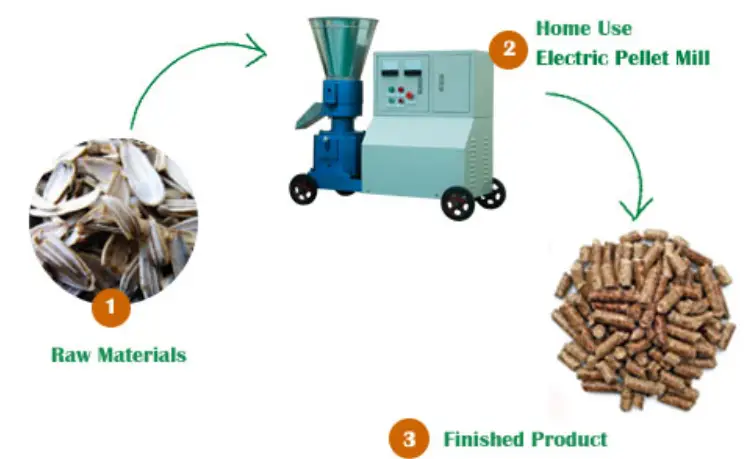
2. Overview of the production flow
A robust pellet line for chips typically follows these sequential stages:
-
Receiving and storage.
-
Primary chipping and foreign object removal.
-
Size reduction to fine particles (hammer mill or grinder).
-
Sieving to remove oversized fragments.
-
Moisture reduction in a dryer to the pelletizing target.
-
Pelletizing in a ring die or flat die pellet mill.
-
Cooling and tempering to stabilize mechanical strength.
-
Screening to remove fines and under-sized pellets.
-
Packing, bagging or bulk loading for transport.
Each stage affects final pellet durability, calorific value and yield. Industry guides and plant case studies emphasize the drying and milling steps as decisive for pellet quality.
3. Raw material selection and quality criteria
Not all chips are equally suitable. Key attributes to evaluate before production:
-
Species and wood type: Hardwood pellets often have higher bulk density and slower combustion, while softwood offers higher resin-laden binders in some species. Choose feedstock based on desired pellet characteristics.
-
Contaminant level: Metal, rock, sand, foreign plastics or soil will damage mills and dies and must be removed by magnets, air separators and screening.
-
Initial moisture: Fresh chips can be 30–60 percent wet. Pre-drying or blending with drier material reduces the dryer load.
-
Particle geometry: Chips are coarse; pellet formation requires fine particles below roughly 3 millimeters for consistent compaction, so efficient milling is required.
Practical tip: set up an incoming inspection to log species, moisture, and contaminants so you can decide whether the lot needs additional pre-treatment.
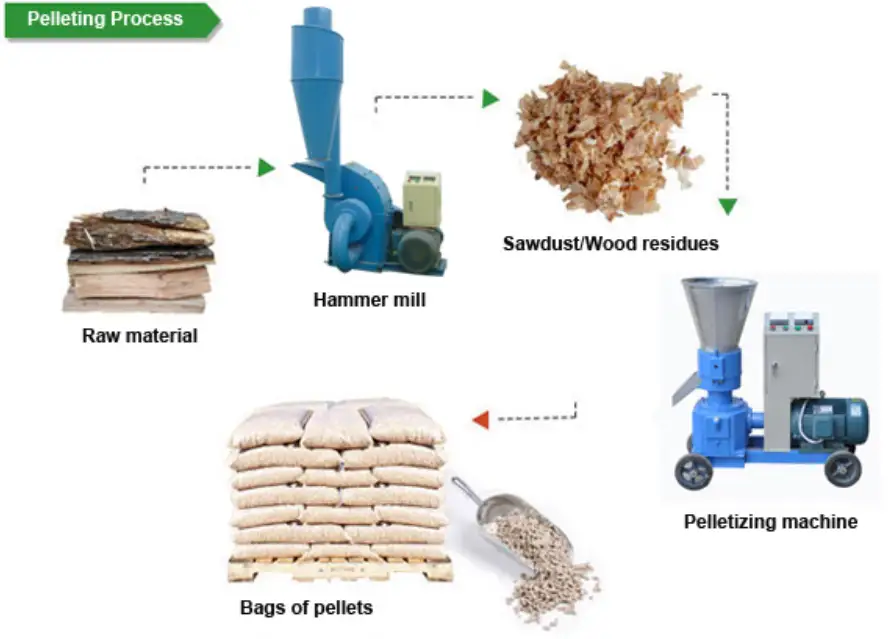
Learn the easiest steps to make wood pellets at home
4. Pre-processing: chipping, milling and sieving
Chips from log processing or forest residues must be reduced to the particle size range suited to the pellet mill. The typical chain is chipping → hammermill/knife mill → vibrating screen.
-
Chipper: Converts large pieces and branches into manageable chips for further milling. Choose a chipper size for your feedstock and throughput.
-
Hammer mill: Most pellet plants use a hammer mill to produce a powder-like feed. Target mean particle sizes under 3 mm; particles above this size will reduce pellet cohesion and increase die wear. Efficiency and wear depend on rotor speed and hammer configuration.
-
Screens and classifiers: These separate oversize pieces that may require secondary milling. Effective screening reduces the load on the dryer and pelletizer.
Processing chips into a uniform fine powder is energy intensive but essential; poor milling is the most common cause of inferior pellets.
5. Moisture control and drying targets
Moisture is the single most important variable for pellet quality. Two facts to hold in mind:
-
Target moisture: Most industrial operations aim for about 8 to 12 percent moisture for wood pellets prior to pelletizing; this balance allows lignin plasticization and produces firm pellets. Higher moisture reduces output and may produce crumbly pellets; lower moisture increases grinding energy and can reduce binding.
-
Dryer types: Drum dryers and belt dryers are common for chips. Drying design must balance throughput, fuel source and allowable exhaust heat. Some plants use bark or process fuel to heat dryers.
Control strategy: monitor inlet/outlet temperatures and use in-line moisture sensors where possible to protect die life and pellet quality. Final pellet moisture after cooling typically sits around 4–6 percent, which is ideal for long-term storage.
6. Pelletization: machines, dies, rollers and operating parameters
Pelletization is the heart of the process. Two common mill types are used:
-
Ring die pelletizer: Favored in medium to large plants for higher throughput and longer continuous operation. A rotating ring die with roller assemblies compresses material through die holes. Ring die mills handle wood chips (after milling) more efficiently and offer better die life for heavy-duty use.
-
Flat die pellet mill: More common for small batch or home-scale production. It is simpler but has lower throughput and typically higher labor intensity. For chips to pellets at scale, ring die tends to be preferred.
Key parameters that operators tune:
-
Feed rate and screw speed to maintain consistent die fill.
-
Die temperature influenced by friction and can aid lignin softening.
-
Roller pressure and die clearance that determine pellet density.
-
Die-hole size to meet target pellet diameter (commonly 6, 8 or 10 mm for fuel pellets).
Note: wood contains natural lignin which acts as an intrinsic binder when heated and compressed; synthetic binders are not normally required for pure wood pellets if particle and moisture targets are achieved.
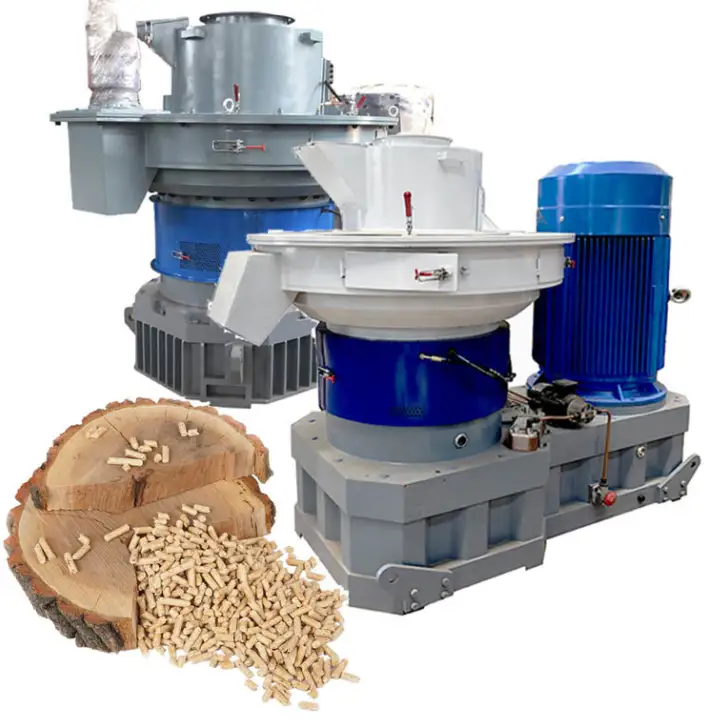
7. Post-pelletizing steps: cooling, screening, storage and packing
After extrusion pellets are hot and fragile; the immediate steps are:
-
Cooling: A counterflow cooler reduces pellet temperature and solidifies surface lignin, raising mechanical durability. Cooled pellets also reach a stable moisture equilibrium.
-
Screening: Vibratory screens separate fines and dust. Fines are recycled back to the hammer mill or blended into future batches.
-
Storage: Store in dry, ventilated warehouses or sealed big-bags to avoid moisture pickup and biological degradation. Bulk storage requires considerations for spontaneous heating in deep piles.
-
Packing: Automated bagging systems increase labor efficiency; bulk loading into trucks or containers is common for industrial customers.
A plant layout that minimizes material handling between pellet press, cooler and packer reduces breakage and improves yield.
8. Quality metrics and laboratory tests
Customers and standards bodies expect measurable quality metrics. Common tests include:
-
Moisture content after cooling (target 4–6 percent for finished pellets).
-
Bulk density (kg/m3) – higher density improves transport economics.
-
Durability or mechanical strength measured by tumbling tests; acceptable values for premium fuel pellets typically exceed 95 percent durability.
-
Ash content – lower is better; high ash can cause fouling in boilers.
-
Calorific value (higher heating value) reported in MJ/kg or BTU/lb.
-
Particle size distribution and fines percentage after screening.
Standards and buyer specifications vary by market; adopt a simple QC lab routine for each production shift.
9. Typical equipment layout and plant configurations
Plant design depends on throughput. Typical modules for a small to medium plant:
-
Receiving and storage: covered bays, conveyors and shredders
-
Primary chipper and hammer mill: staged reduction units, magnets and screens
-
Drying line: drum dryer or belt dryer with dust collection and flue handling
-
Pelletizing island: pellet mill(s), feeders and control panels
-
Cooling and screening: cooler, screen and return conveyors for fines
-
Packing and palletizing: bagging machine, palletizer and stretch wrapper
For continuous operation, design for redundancy on critical spares: extra die set, spare rollers, and a second hammermill if throughput or feed variability is high. Plant layout can be modular to scale with demand.
10. Energy use, yields and rough cost considerations
Energy demand and yield will vary based on initial moisture, species, and plant efficiency. Some rules of thumb:
-
Yield loss: volume and mass are reduced during drying; expect noticeable mass loss when bringing green chips to pellet moisture.
-
Energy consumption: grinding, drying and pelletizing are the main energy sinks. Efficient drying and heat recovery reduce operational cost. Using process residues like bark as dryer fuel can lower fuel bills.
For project planning, perform a feedstock mapping exercise, a dryer sizing calculation, and a simple ROI model that includes capital for chippers, hammermill, dryer, pellet mill, cooler, screens and packing plus working capital for feedstock. The WSU report and regional extension notes are useful references for feasibility modeling.
11. Environmental, safety and regulatory considerations
Consider these operational imperatives:
-
Dust control and explosion risk: Pellet plants produce combustible dust. Install proper dust collection, grounding and explosion vents or suppression systems.
-
Emissions from dryers: Combustion gases and particulates require compliance with local air permits. Flue treatment may be required for industrial dryers.
-
Sourcing legality: Verify timber sourcing rules and sustainability commitments required by certain buyers or certification programs.
-
Fire protection: Deep bulk storage can self-heat; monitor temperature in piles and design for fire retardant procedures.
Addressing these early reduces regulatory friction and enhances buyer confidence.
12. LansonMachines product fit and purchasing notes
For customers considering equipment, key questions to align to supply and business model:
-
What is your design throughput in tons per hour and per year?
-
What incoming chip quality and moisture profile should we expect?
-
Will you use process fuel or electricity for the dryer?
-
Is automation level and remote monitoring required?
LansonMachines supplies pellet presses, hammer mills and modular pellet lines with factory price advantage and customization options for feedstock and capacity. When comparing suppliers, prioritize die metallurgy warranties, availability of spare parts, and local service. (Company-specific specification pages and data sheets are recommended for final selection.)
13. Tables
Table 1: Typical target specifications for wood pellets (fuel use)
| Parameter | Typical range | Notes |
|---|---|---|
| Finished moisture (after cooling) | 4 – 6% | Best for long storage and low biological activity. |
| Pellet diameter | 6, 8, or 10 mm | Market depends on stove or boiler design. |
| Bulk density | 600 – 750 kg/m3 | Denser pellets reduce transport cost. |
| Durability | > 90–95% | Industry premium typically above 95%. |
| Ash content | < 1–3% | Species dependent; lower ash preferred. |
Table 2: Equipment comparison – small, medium and large scale
| Function | Small scale (hobby/home) | Medium (local plant) | Large (industrial) |
|---|---|---|---|
| Chipper / shredder | Small electric/hydraulic | Medium diesel/hydraulic | High capacity industrial |
| Milling | Flat die with grinder | Hammer mill with screens | High capacity hammer mills, multi-stage |
| Dryer | Small batch or solar assist | Drum or belt dryer | Large rotary drum with heat recovery |
| Pellet mill | Flat die | Small ring die | Large ring die with automated feeders |
| Cooling / screening | Simple cooler and hand screen | Rotary cooler and vibratory screen | Large counterflow coolers, inline screening |
Table 3: Quick process checklist for chips-to-pellets
| Step | Pass/fail checkpoints |
|---|---|
| Incoming inspection | Species, moisture, contaminants logged |
| Milling | Particle size < 3 mm average |
| Drying | Outlet moisture 8–12% at pelletizing inlet |
| Pelletizing | Die temp stable, steady throughput |
| Cooling | Pellets < 40°C and moisture target |
| Screening | Fines < specified percent |
| Packing | Bag weight accuracy and sealing integrity |
14. FAQs
-
Can I make pellets directly from chips without milling?
No. Chips are too coarse to form robust pellets; a hammer mill or other size reducer to produce particles under about 3 mm is needed. -
What moisture should chips be before pelletizing?
Aim for 8–12 percent moisture entering the pellet mill; finished pellets should be around 4–6 percent after cooling. -
Are binders required for wood pellets?
Pure wood pellets normally rely on natural lignin and do not require added binders if particle size and moisture are correct. Some low-lignin feedstocks may need a small binder addition. -
Which pellet mill type is best for chips?
Ring die mills are preferred for medium and large-scale chips-to-pellet production because they handle higher throughput and heavy duty operation. -
How do I control dust and explosion risk?
Install robust dust collection, maintain good housekeeping, ground equipment and use explosion vents or suppression where required. -
What species make the best pellets?
Both hardwood and softwood can produce quality pellets; species selection depends on ash tolerance, calorific needs and regional availability. -
How much mass is lost during drying?
Substantial weight loss occurs when drying green chips to pellet moisture; plan feedstock volumes accordingly. Exact loss depends on initial moisture. -
Can fines be reused?
Yes. Fines are typically recycled into the grinding feed to improve yield. However excessive fines indicate upstream problems. -
Is it economical to pelletize small volumes?
Small-scale pelletizing is technically possible but often uneconomic because of energy for milling and drying; economies of scale favor medium or larger plants. -
How do I test pellet quality?
Measure moisture, bulk density, mechanical durability and ash content using standard test methods; perform routine sampling per shift.
15. Practical checklist to start producing pellets from chips
-
Map feedstock availability and seasonal moisture trends.
-
Select target pellet specification for your market (diameter, ash, calorific).
-
Size the dryer and hammermill for throughput and typical chip moisture.
-
Choose ring die pellet mill size based on capacity plan and operating hours.
-
Incorporate cooling, screening and bagging modules in the material flow.
-
Design dust control and fire protection into building layout.
-
Budget spare parts and set preventive maintenance schedule for die and rollers.
-
Run pilot batches to validate QC and adjust moisture or milling as needed.